
We often imagine the story of Europe beginning in the sunlight of the Renaissance, or the orderly marble of the Roman Senate. But the "founding fathers" of the modern world were born in a long, cold twilight, a period vividly captured by the early Alma-Tadema Merovingians series.
This is the history of the Merovingians, a dynasty of "Long-Haired Kings" who emerged from the dense Ardennes Forest to claim the ruins of the Roman Empire. This vast woodland in southeast Belgium was their heartland—a place where they remained independent from Roman authority. They were part of a group known as the Franks, a name that likely came from an old word for "spear" (franca), but eventually came to mean "the free." These tribal warriors were the founding fathers of modern Belgium. A young artist named Lawrence Alma-Tadema was living in Antwerp, just a short journey north of this ancient forest, when he first became obsessed with its dark and violent history. This is not a story of treaties and laws; it is a story of blood-oaths, throwing axes, and a mother’s quest for revenge.
The Midnight of an Empire (The Fall of Attila)
Before the Alma-Tadema Merovingians could rise, the "Other" had to fall. In 453 AD, the Western world was under the iron thumb of Attila the Hun, the man known as the "Scourge of God." He had pushed the Roman Empire to the brink of collapse, holding his vast territory together by the sheer force of his terrifying personality.
But Attila’s end was not a glorious death on the battlefield.
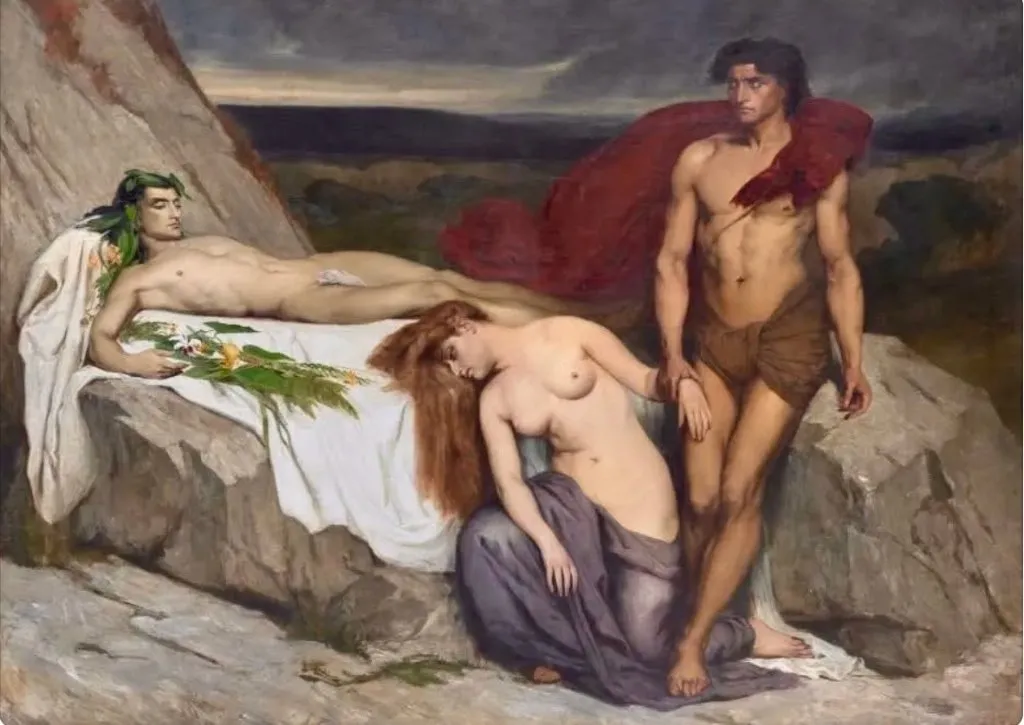
His death caused his empire to fragment instantly. The power vacuum he left behind was the "necessary chaos" that allowed the Frankish tribes—the ancestors of modern Belgium and France—to emerge from the darkness and claim the stone walls of the Roman world, a transition that defines the cultural weight of the Alma-Tadema Merovingians.
The Widow’s Vengeance (The Story of Clotilde)
One of the most consequential figures of the Alma-Tadema Merovingians is Queen Clotilde. Her story is a Greek tragedy set in the Gallo-Roman world. Her father, the King of the Burgundians, was murdered by his own brother, Gondebaud. Her mother was drowned with a stone around her neck. Clotilde survived only to be married off to the Frankish King Clovis.
While Clotilde is often remembered for converting Clovis to Christianity, her true historical legacy was her memory. She never forgot the blood of her parents. When Clovis died of natural causes in 511 AD—a relatively young man of 45, passing away from illness in his new capital of Paris—his kingdom was partitioned among his four sons according to Frankish custom. But Clotilde did not retire to a convent; she turned her nursery into a barracks.
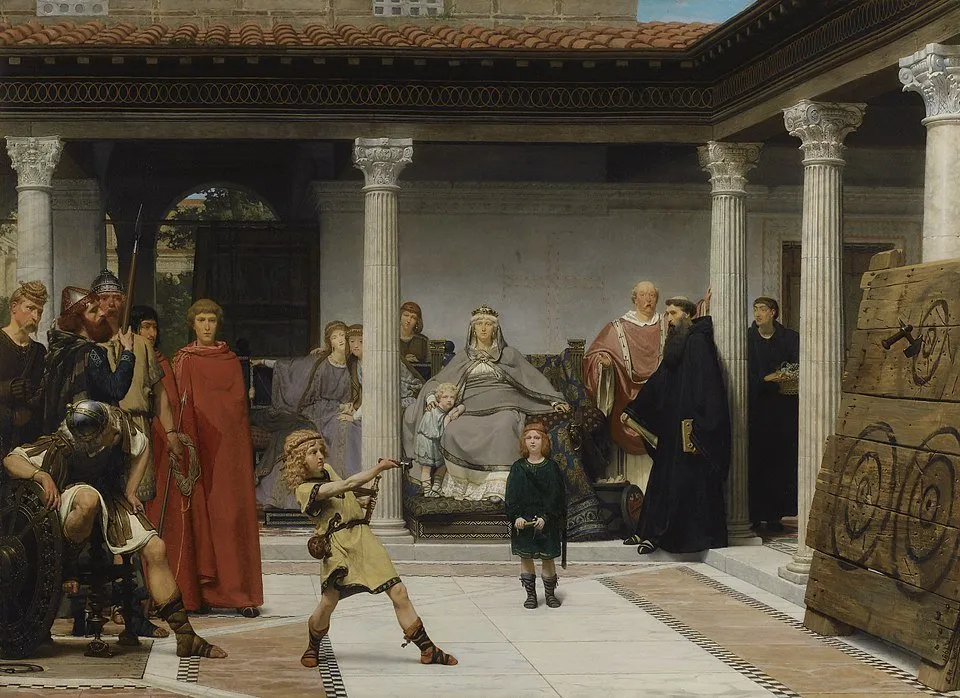
In this scene, we see Clotilde’s three sons—Chlodomer, Childebert, and Clothar—undergoing their "education." It was a training dictated by their mother’s thirst for justice. They are being taught the mastery of the francisca, the signature Frankish throwing axe (a weapon so synonymous with the tribe that it shared its name), because Clotilde was forging them as the instruments of her revenge—the weapons that would eventually strike the heart of her uncle Gondebaud, the man who had murdered her father and drowned her mother.
The eldest son, Chlodomer, has just released his blade; the second, Childebert, stands ready; while the youngest, Clothar (Clotaire I), clings to her robes. There is a deep historical irony in this visual detail. The child who seems the most hesitant, hiding in the folds of his mother's dress, is the transition point for the dynasty. He would grow up to be the most ruthless of them all—the only brother to survive the family culls he helped initiate, eventually reunifying the kingdom and siring the next generation of "scorpions" we meet in Act II.
In this moment, however, she is training them early, treading their Frankish leather shoes (tied in the particular tribal fashion with long thongs crisscrossing high up the leg) across the beige and cream-veined marble of their scavenged Roman palace.
Her sons would eventually honor her oath by crushing the Burgundians, but the education in violence she gave them would eventually turn inward, causing the brothers to murder their own kin—a dark turning point for the Alma-Tadema Merovingians.
The Tragedy of the Survivor
Clotilde lived to see her vengeance against the Burgundians, but she also lived to see the horrific fruit of the "education" she had provided. The greatest tragedy of her late life occurred after the death of her eldest son, Chlodomer, in battle. She took his three young sons—her beloved grandchildren—under her protection in Paris.
Her remaining sons, Childebert and Clothar, consumed by the same ambition she had fostered, conspired to steal their dead brother’s kingdom. They sent a messenger to Clotilde with a choice that has become one of the most chilling anecdotes in the history of the Alma-Tadema Merovingians. The messenger presented her with two items: a pair of scissors and a naked sword.
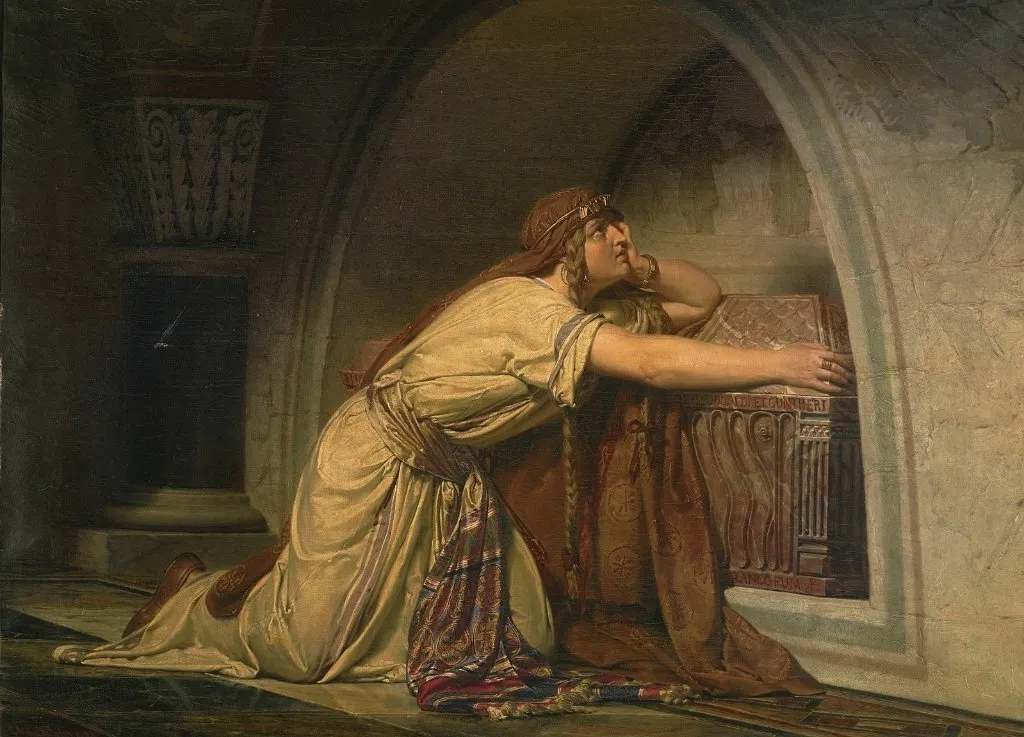
The message was clear: would she rather see her grandchildren shorn of their long hair (thereby losing their royal status and being forced into a monastery) or slain? Distraught and cornered, Clotilde reportedly cried out that if they were not to be kings, she would rather they were dead than shorn.
Her sons took her words as a warrant. Clothar personally stabbed the two older boys, Theodebald and Gunthar, while the youngest, Clodoald, was smuggled away by loyalists to become a monk. This painting shows a Queen who won her war but lost her family—a woman standing in the cold shadows of a future where the blades she sharpened were eventually turned against her own heart.
The Historian’s Debrief: Propaganda & Prestige
While the history of Clotilde is a raw account of 6th-century power, why did a young Lawrence Alma-Tadema choose to paint these specific scenes in 1860?
1. The Search for a National "Cradle"
In 1860, Belgium was a new nation (independent for only 30 years) and was desperately searching for its own history. The subjects of the Alma-Tadema Merovingians, whose "cradle" was fixed in the Belgian city of Tournai following the famed 17th-century discovery of the gold treasure in the tomb of King Childeric I (including the legendary golden bees), were the perfect "Founding Fathers." By painting them, a 24-year-old Lawrence Alma-Tadema was giving the young Belgian King, Leopold I, a set of ancestors that were neither French nor Germanic, but uniquely Frankish.
2. The Victorian "Social Flex"
For the educated elites who eventually bought these paintings, these obscure history lessons served as a marker of status. To recognize the name of Clotilde or the "Throne of Dagobert" without looking at the catalogue was a signal of elite education. These paintings allowed the Victorian viewer to gaze at the "barbaric" roots of Europe and congratulate themselves on how far their "civilized" age had come.
3. The Texture of Truth
This "Dark Phase" was where the vision for the Alma-Tadema Merovingians invented the technique that would make him famous. Before he mastered the sunlight of Rome, he had to master the coldness of the stone and the weight of the iron. He learned here that history isn't just dates; it's the texture of the grain in an oak beam and the way a leather thong wraps around a prince's leg.
In Part II of this series, we move from the nursery to the palace, deepening our study of the Alma-Tadema Merovingians as the axe is replaced by the gaze, and a new Queen, Fredegonda, emerges from the shadows to claim the throne.
Leave a Visiting Card
Consulting the visiting cards...