
Imagine a space where sixteen hundred people are naked at once. The air is thick with the scent of Egyptian roses and the humid breath of a thousand furnaces. This was the daily reality of the Baths of Caracalla—a five-star palace gifted by an Emperor to his people, where the marble was as cold as the politics were hot.
But here's the question that haunted the Roman state: How do you keep a restless population loyal when your throne is soaked in blood?
The answer, it turns out, was hot water.
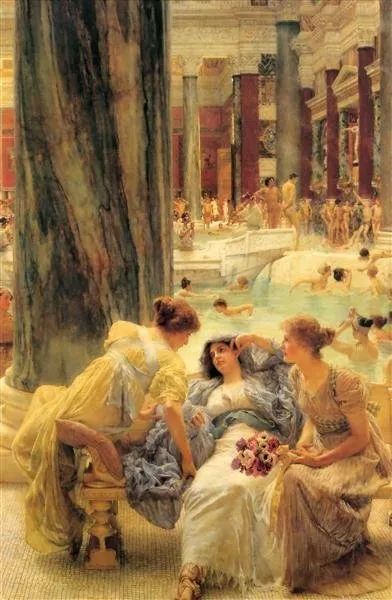
The Most Expensive Distraction in History
In his 1899 masterpiece, The Baths of Caracalla (Opus 356), Sir Lawrence Alma-Tadema—the definitive Classical painter of the Victorian age—captures the overwhelming scale of this imperial project. We do not see the whole building; no canvas could hold it. But we see the light. It pours down from a height that rivals a modern cathedral, illuminating the blue-veined marble shipped from quarries across the Empire. Tadema drew his inspiration from the poetry of Alfred Lord Tennyson: "A Court, compact of lucid marbles... betwixt the pillars and great urns of flowers."
This was not just a bathhouse. It was a political weapon.
The Emperor Caracalla—who would murder his own brother in their mother's arms just to secure the throne—understood something fundamental about power: people will forgive almost anything if you make them comfortable. So he built the Baths of Caracalla on a scale that defied reason. The structure could hold sixteen hundred bathers at once, all walking on imported marble, all breathing the same steam as Senators and slaves alike. For a nominal fee, the poorest citizen of Rome could experience a luxury that would make a modern billionaire jealous.
This practice had a name: evergetism—public generosity as a form of control. It was the "Bread and Circuses" of plumbing, a way to keep the masses distracted while the Empire tore itself apart at the top. And it worked. As long as the furnaces stayed lit and the water stayed hot, the people stayed quiet.
The Architecture of Forgetting
The genius of the Baths of Caracalla was not just in their size, but in their design. The building was built to make you forget. Forget the noise of the street. Forget the violence of the arena. Forget that your Emperor was a murderer.
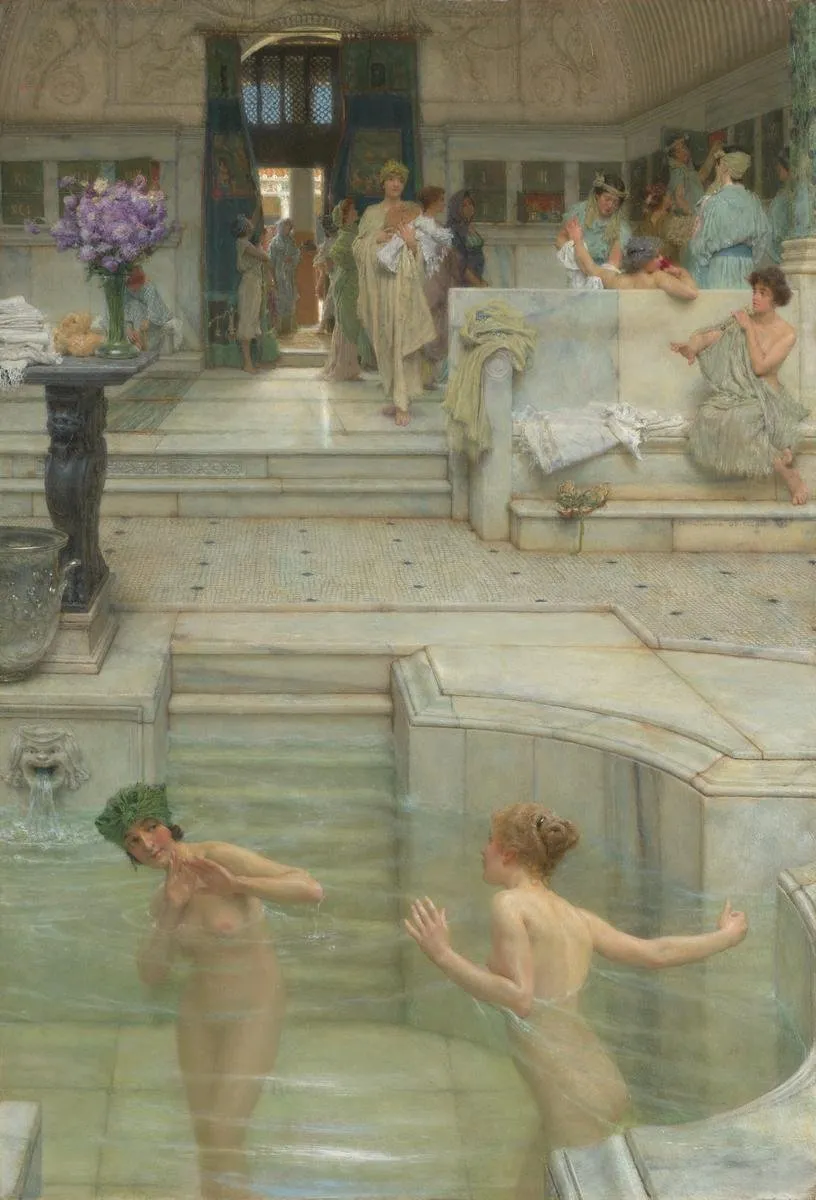
Tadema understood this. In A Favourite Custom (Opus 391), he shows us the cold plunge room—a space of crystalline water and echoing silence. The ceiling is fluted with rhythmic grooves, a detail he "borrowed" from the hot room of the Stabian Baths in Pompeii because it was more beautiful to the eye. This was Tadema's own form of evergetism: choosing beauty over accuracy, seduction over truth.
And that was the point. The Baths of Caracalla were not designed to be truthful. They were designed to be overwhelming. The swimming pool was open to the sky, surrounded by walls that rose fifty feet into the air. The social hierarchy that defined every other inch of Roman life melted away in the steam. For a few hours, a beggar could sit in the same water as a Senator, and both would leave feeling like kings.
It was efficient. It was beautiful. And it was designed to make you believe that this was what Rome owed you—not because you were a citizen, but because you were Roman. The architecture itself was propaganda, every column a reminder that the Empire could afford to be generous because it was invincible.
But the true elite knew the secret: the best luxury is the kind you don't have to share.
The Escape Hatch
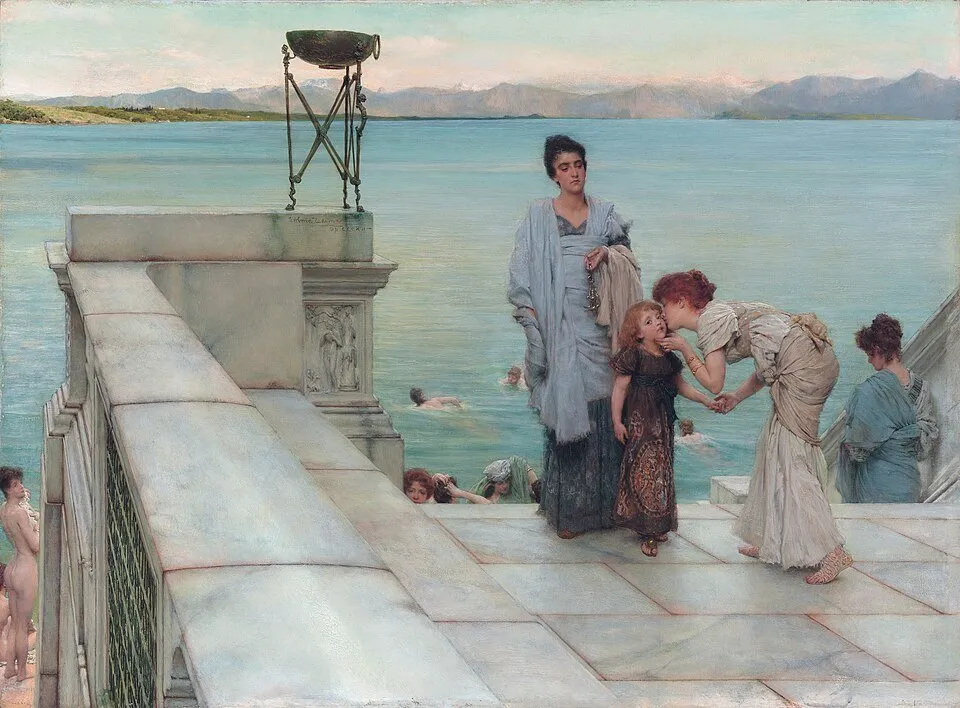
In The Kiss (Opus 312), Tadema shows us the alternative: a private villa by the sea, where bathing is not social or political, but domestic and quiet. The background shows a lake that Tadema modeled after a trip to Bavaria, yet it perfectly captures the Roman idea of otium—a cultivated leisure away from the noise of the city. If the Baths of Caracalla were the public square of the body, the seaside villa was its private chapel.
This was the final irony of the Imperial baths: they were designed to make everyone feel equal, but they only reminded the elite of how much better it was to be alone.
The Silence After the Fall
Today, the Baths of Caracalla stand as skeletal giants in the Roman sun, their marble stripped and their furnaces cold. The Emperor is gone. The water has stopped flowing. But the ruins still whisper the same question: What does it cost to keep a population happy?
The answer, it turns out, is everything.
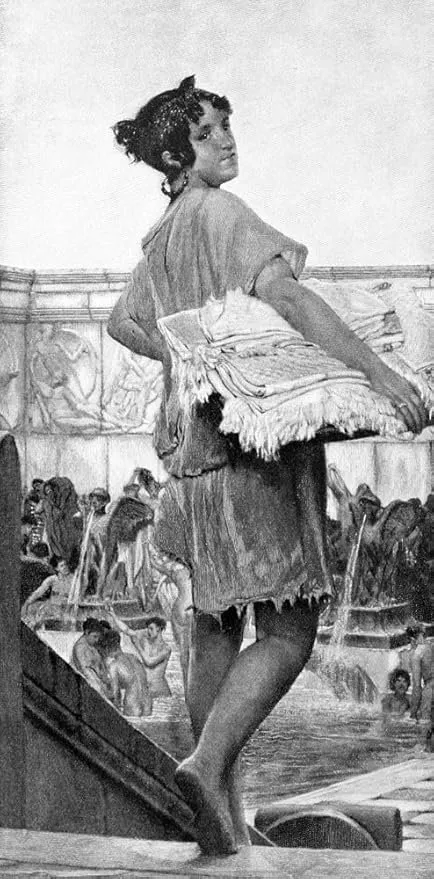
The architecture was not built to last. It was built to overwhelm. And in the silence of the ruins, the echo of that sixteen-hundred-person splash still rings out—a reminder of an empire that once tried to bottle the sun and give it away for free.
Yet the serendipity was an illusion.
But the marble did not scrub itself, and the furnaces did not feed themselves. In the shadows of these great halls, another empire was at work. And who kept this machine running?
Next, meet the balneatrices, the women bath attendants who saw everything but said nothing.
Next in the Trilogy: The Slaves Who Knew All Your Secrets
Leave a Visiting Card
Consulting the visiting cards...