
To be the daughter of a giant is a heavy burden, and Anna Alma Tadema carried that weight her entire life.
She was born in Brussels on May 16, 1867 (though she is often incorrectly cited as being born in 1865). Her world was one of paint and marble. Her father was Sir Lawrence, the most famous painter in England. Her stepmother was Laura, a celebrated artist in her own right.
The house trembled with creativity. It smelled of oil paint, turpentine, and exotic flowers. It was filled with Roman statues, brass skins, and tiger rugs. It was a palace of art.
And Anna? She was a prodigy, though as her sister Laurence once noted, she was "unaided" by her father—finding her own "salvation" through observation and the mentorship of their stepmother, Laura.
The Girl Who Saw Everything
From a young age, Anna Alma Tadema had an eye that missed nothing.
In 1874, when she was just seven years old, the famous Regent's Park barge explosion shattered their home. While the windows blew in and the ceiling collapsed, raining hundreds of hazelnuts onto her bed from the attic store, Anna remained bizarrely calm. In the pitch darkness, she simply told her sister: "Ring the bell."
This strange composure defined her art. While other children played with dolls, she played with perspective. She learned to see the world in microscopic detail. She didn't just see a carpet; she saw every thread.
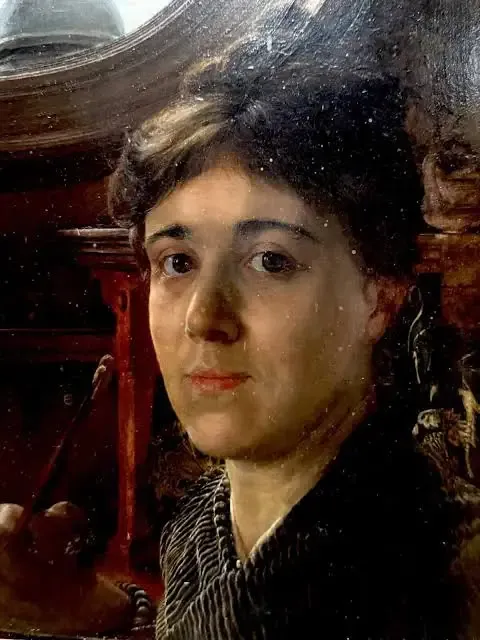
By 1885, when she painted The Drawing Room, Townshend House, her obsession was fully formed. She signed her work with a distinctive lowercase 'a'—a quiet, typographical rebellion to distinguish herself from the capital 'A' of her famous father.
"Unaided Salvation": The Myth of the Student
Critics constantly assumed that Anna was simply her father's pupil. They were wrong.
In a 1908 interview, her sister Laurence clarified the truth: "People always say 'why shouldn't she paint with her father to teach her all the time?' He has never taught her directly... she has had to work out her own salvation without his aid."
In fact, her formal education wasn't in art at all. Records uncovered by art historian Susie Beckham reveal that in 1882, Anna enrolled at Bedford College—not to draw, but to study English Language. She was an intellectual who chose painting, not a painter by default.
She was also surrounded by a maternal dynasty of artists. Her stepmother Laura was a painter; her aunt Emily Williams was a painter; her aunt Ellen Gosse was a painter. When Anna painted the Drawing Room in 1885, her aunt Emily was painting the exact same room at the same time. This wasn't just a father-daughter studio; it was a complex, female-led artistic hive.
The Rebel and the Survivor
She was also a modern woman. Unlike her father’s fantasies of ancient Rome, Anna lived in the real, turbulent world.
In 1897, Anna Alma Tadema was documented as a supporter of the Women's Suffrage Movement. But her resilience was tested beyond politics. In 1901, she suffered a "nervous condition" that caused total blindness for nearly a year. For twelve months, the girl who lived by her eyes was plunged into darkness. Yet, she returned to the canvas with her vision sharper than ever.
During the Great War, she worked tirelessly for the War Refugees Committee, helping Belgian families displaced by the conflict. In 1918, she was awarded an MBE for her service—a professional honor that official scholarship often overlooks.
The Legend of the Lost Peace Commission
The most persistent myth about Anna is that she faded away after her father’s death in 1912. The truth is far more dramatic.
From 1919 to 1927, Anna spent eight years on a massive commission: painting the History of the Paris Peace Conference. American newspapers reported that she was in Paris "starting her great work," sitting alongside official war artists like William Orpen.
She dedicated nearly a decade to documenting the faces of the men who redrew the map of the world. Yet today, these paintings are lost—likely tucked away in an institutional archive or destroyed in the "muddle" of the mid-century. It remains one of the great missing chapters of British war art.
The "Caravan Style" Final Years
Legacies can crumble, and the fate of the sisters was inevitably tied to the changing tides of taste. After Sir Lawrence died, critics mocked the "marble school" as kitsch.
Anna and Laurence watched their world be stripped bare. In 1921, they watched the "Roman Villa" in St John's Wood being purchased by auctioneers and subdivided.
In her final years, Anna lived at the Hotel Washington on Curzon Street. Laurence described her life as "caravan style"—living in a "muddle" in a darkened, nearly closed-down hotel with poor food and little service. Yet, as her sister noted, "I can't see that it matters." She remained a survivor of a golden age that no longer existed.
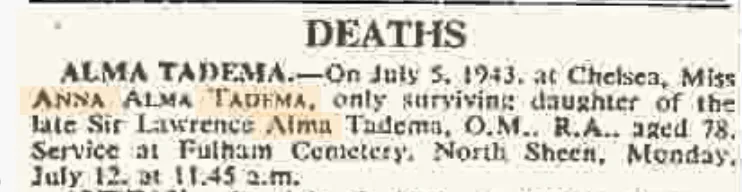
She passed away in 1943, at the age of seventy-six. She died in Chelsea, alone in the Blitz-battered city, her last signatures a shaky, frail testament to the woman who had once gripped her paintbrushes in a fist of defiance.
The Lost Phoenix
Perhaps the most poignant symbol of her career is a painting that, like so much of her life, has vanished.
In 1896, she exhibited Hope the Phoenix. It depicted a spirit rising from the ashes of its own destruction, her face looking heavenward. It is a fitting metaphor for an artist who went blind and returned to paint; who lived through the destruction of her home and kept working; who died in the Blitz and is only now being remembered.
A Rediscovered Genius
Art is patient. Today, we look at The Drawing Room or her Self-Portrait and we do not see a relic. We see a marvel.
We see the genius of Anna Alma Tadema clearly now. We see the suffragette who believed in the future, the war worker awarded for her mercy, and the artist who spent eight years painting the peace of nations. She carried the weight of her name to the end, but her work stands entirely on its own.
This article draws significantly on the pioneering research of Susie Beckham (University of York), whose work has been instrumental in recovering the true birth date, political life, and lost history of Anna Alma-Tadema.
Leave a Visiting Card
Consulting the visiting cards...