
There is a child missing from the biographies of Alma Tadema.
Most sources list two children from his first marriage: Laurence and Anna, the daughters who survived into old age, who became artists and writers, whose lives are documented in letters and photographs and the careful records of Victorian society.
But there were three children.
The firstborn was a son. He lived approximately six months. Smallpox took him sometime in mid-1864, in Brussels or Antwerp, in a room we cannot name, on a date that was never recorded. His name—if he had one long enough to be baptized—has been lost to history.
He exists only as "the firstborn son," a footnote in a few scholarly texts, a gap in the genealogical record. The silence surrounding him is itself devastating. He was born, he suffered, he died, and history forgot him.
Only the grief remained.
The Rushed Wedding
September 24, 1863. Lawrence Alma-Tadema, twenty-seven years old and rising in the art world of Antwerp, marries Marie-Pauline Gressin-Dumoulin de Boisgirard. She is French, the daughter of a journalist living in Belgium. The wedding is respectable, proper, documented.
But the timeline whispers something else.
Their son was born late in 1863 or early in 1864—three to six months after the wedding. If he arrived in late 1863, he was conceived before the marriage vows were spoken. In the rigid moral landscape of 1860s Catholic Belgium, this was catastrophic. Premarital pregnancy carried a stigma that could destroy a middle-class family's reputation. Unmarried pregnant women were "fallen women." Their children were "bastards," denied inheritance, denied legitimacy, denied a place in polite society.
Was the wedding rushed to cover the scandal? The speed of it—no long engagement mentioned in any record, no elaborate courtship documented—suggests urgency. Perhaps love. Perhaps necessity. Perhaps both.
We will never know. But we know that within months of the wedding, a child was born. And within months of that birth, he was dead.
The Woman Who Disappeared
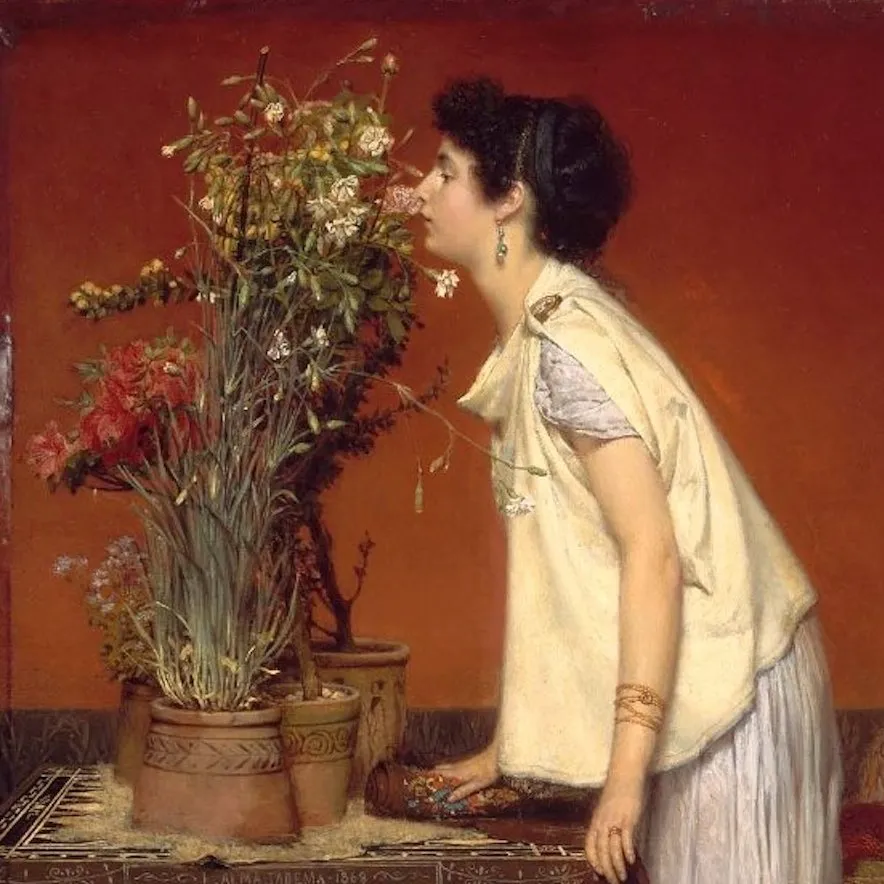
Marie-Pauline Gressin-Dumoulin de Boisgirard. French. Daughter of Eugène Gressin, a journalist. Cultured, connected to the artistic circles of Brussels. She modeled for Alma Tadema's paintings in the early years—her face appears in "Boating" (1868), a Roman scene now in the Museum Mesdag.
After their honeymoon to Pompeii in 1863, they moved to Brussels and painted their studio walls the red of Pompeian frescoes. It was their shared dream—to recreate the ancient world in a Belgian townhouse.
But history has been unkind to Pauline. Compared to Laura, Alma Tadema's second wife, who appears in dozens of paintings and hundreds of letters, Pauline is almost invisible. He painted her only three times during their marriage. She left no letters, no diary, no voice of her own.
She exists only in fragments: a name in a marriage register, a figure in a painting, a mother who died too young.
The Mathematics of Infant Death
Smallpox in the 1860s was not merely a disease. It was a culling. For infants under one year of age, the case-fatality rate ranged from eighty to ninety-eight percent in major European cities. The younger the child, the higher the death rate. A six-month-old infant had almost no chance of survival.
The disease began with fever. Then the rash—first in the mouth and throat, then spreading across the face and body. The pustules formed, filled with fluid, burst, scabbed over. If the child survived the fever, they might still die from secondary infection. If they survived that, they were left scarred for life.
Most did not survive.
Alma Tadema's son was among the majority. He died sometime in mid-1864, his small body ravaged by a disease that had no cure, no treatment, no mercy.
The boy had no chance. And his father—who would spend the rest of his life painting scenes of perfect, idealized beauty—could do nothing but watch him die.
The Slow Unraveling
After her son died, Pauline began to suffer from what the records vaguely describe as "several years of health problems." Whether she had contracted a mild case of smallpox that weakened her immune system, or whether the grief itself manifested as physical illness, we cannot know. Victorian medicine did not distinguish between psychosomatic and organic disease. A woman who could not stop weeping was simply "hysterical." A woman who could not eat was "melancholic."
Pauline was both.
Yet she bore two more children. In August 1865, barely a year after burying her son, she gave birth to Laurence. In 1867, still suffering, still weakened, she bore Anna. For five years, Alma Tadema watched his wife decline—dying slowly, in installments, while raising two daughters who would never know their older brother.
On May 28, 1869, the disease that had taken their son returned. Pauline died of smallpox at the age of thirty-two. The same virus that had killed her infant son five years earlier came back to finish what it had started.
The Breakdown
When Pauline died, Alma Tadema collapsed.
"Disconsolate and depressed," the biographers write, as if those two words could contain the enormity of what he felt. He stopped painting for four months—May, June, July, August. For an artist who painted obsessively, who filled canvas after canvas with meticulous detail, who worked from dawn until the light failed, this silence was unprecedented.
He was thirty-three years old. A widower. A father to two toddlers—Laurence, age four, and Anna, age two—who did not understand why their father could not stop crying, why the studio door stayed closed, why the house felt like a tomb.
His sister Artje moved in to care for the girls, holding the household together while her brother fell apart. She fed them, dressed them, sang to them, told them stories. She kept the world turning while Lawrence sat in his studio, staring at blank canvases, unable to lift a brush.
That summer, he also developed an undiagnosed condition that Brussels doctors could not identify. Was it grief manifesting physically? A psychosomatic collapse? The body's way of saying what the mind could not?
He was broken. Physically. Mentally. Creatively.
And he could not speak of it.
Complete Silence
After Pauline's death, Alma Tadema never spoke about her again.
This is not speculation. Historical sources note it explicitly: "Alma-Tadema reportedly never spoke about her after her death." He painted her portrait only three times during their marriage—a stark contrast to the dozens of portraits he would paint of his second wife, Laura, over the decades to come.
He rarely mentioned his daughters' mother to them. When Laurence and Anna asked about her, he changed the subject. When they grew older and pressed him, he gave them silence.
In December 1869—seven months after Pauline's death—he traveled to London on the advice of his dealer, Ernest Gambart, ostensibly for medical treatment. At the home of painter Ford Madox Brown, he met seventeen-year-old Laura Theresa Epps. Contemporary accounts describe it as "love at first sight."
A thirty-three-year-old widower, broken by grief, having lost his son and wife to the same disease, unable to paint, physically ill, traveling alone for medical help—and then, across a room, a teenage girl who would become his second chance.
Why the silence about Pauline?
Grief, certainly. Guilt—he could not save her or their son. But perhaps something else. If the marriage had been forced by an unplanned pregnancy, did he resent it? If the son's death felt like divine punishment for premarital sin, did Pauline's death bring a guilty sense of relief—freedom from a marriage that had begun under pressure and ended in tragedy?
We will never know. The silence is absolute.
The Painting as Memorial
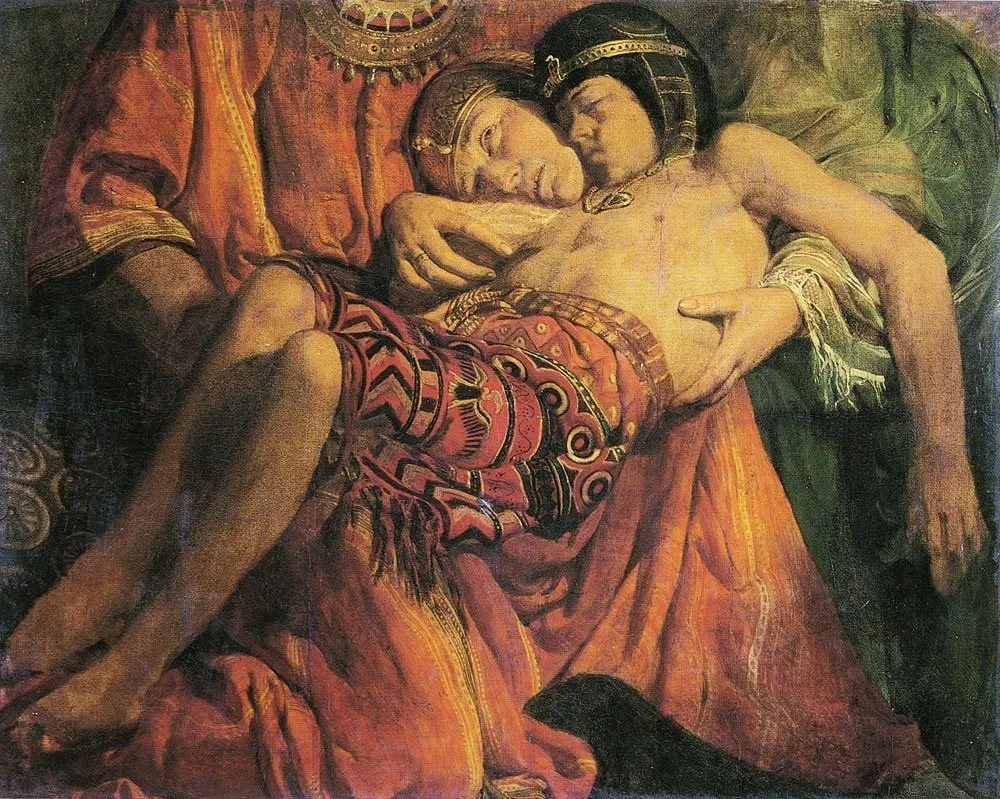
In 1872, eight years after his son's death and three years after Pauline's, Alma Tadema painted "The Death of the First-Born."
The scene is Egyptian, not Belgian. The setting is a temple, not a Brussels townhouse. But the grief is unmistakable.
An Egyptian father—Pharaoh himself—sits on a low stool, holding the lifeless body of his adolescent son across his knees. The boy's mother supports the body from the other side, her face a mask of monumental stillness. Nearby, slaves crouch in the formal attitudes of Egyptian mourning. In the background, priests pray and musicians play instruments, but the music feels distant, muffled, as if heard through water.
"The painting expresses silence," wrote Percy Cross Standing in his 1905 biography. "The painter has avoided any demonstrative expression in the eyes of his sufferers. The colour is rich and low, and thus altogether an antithesis to the sweet brilliance of Mr. Alma-Tadema's habitual work."
No screaming. No drama. No theatrical gestures of despair. Just stillness. Just the terrible weight of a dead child in a father's arms.
This was autobiography disguised as ancient history.
The Egyptian prince has no name in the biblical account—like Alma Tadema's son has no name in the historical record. The father cannot save him, despite all his power and wealth—like Alma Tadema could not save his child, despite all his talent and ambition. The grief is silent, internalized, expressed only through posture and shadow—like Alma Tadema's grief, which he could not speak aloud.
This became his favorite painting. The one he kept in his own possession. The one he called "one of his best works." The one he could not stop painting.
He painted it three times over forty-two years:
1859: "The Sad Father." He was twenty-three, unmarried, working in Antwerp. This was an academic exercise—painting grief he had not yet experienced.
1872: "The Death of the First-Born." He was thirty-six, living in London, remarried, trying to build a new life. This was the masterpiece. This was the version he kept. This was his favorite.
1901: A drawing. He was sixty-five. Twenty-nine years after the second version, he returned to the subject again. The grief had not faded. It had simply become part of who he was.
He could not let it go.
The Escape
Picture Brussels in the summer of 1869.
A widower, unable to paint, physically ill, mentally shattered. Two toddlers who do not understand why their father cannot stop crying, why the house is so quiet, why Aunt Artje speaks in whispers. The rooms where Pauline died. The city where their son died. Memories in every corner, every street, every church bell that tolls for the dead.
In December, his dealer Ernest Gambart advises him to travel to England for medical help. It is presented as treatment—a change of air, consultation with London physicians, rest and recuperation.
But it is also escape.
Escape from the house where Pauline's ghost lingers. Escape from the city that killed his son and his wife. Escape from the unbearable weight of memory.
And in London, in a stranger's drawing room, he meets a girl who smiles at him. A girl who knows nothing of his grief, who sees only the famous painter, the rising star, the man with the exotic double-barreled name. A girl who offers him a future without ghosts.
The New Life
September 1870. The Franco-Prussian War erupts. Alma Tadema uses it as an excuse to leave Brussels permanently. He packs up his household—his daughters Laurence (now five) and Anna (now three), his sister Artje, his paintings, his books, his life—and flees to London.
The official reason is the war. Belgium is neutral, but neutrality is just paper when armies are marching.
But the real reason is deeper. He is fleeing the disease that killed half his family. He is fleeing the memories. He is fleeing to a country where a teenage girl is waiting.
July 1871. Less than a year after arriving in London, Alma Tadema marries Laura Theresa Epps. She is eighteen. He is thirty-five. She becomes stepmother to Laurence and Anna. Artje stays with the family until her own marriage in 1873.
A new life. A new family. A new country.
But the old grief travels with him, packed carefully among the canvases and the reference books, carried across the Channel like a stowaway.
The Weight of Grief
The timeline of loss:
1864. His son dies of smallpox. He is twenty-eight years old.
1869. Pauline dies of smallpox. He is thirty-three.
1872. He paints "Death of the First-Born." He is thirty-six.
1901. He paints it again. He is sixty-five.
1909. Laura dies. He is seventy-three.
1912. He dies. He is seventy-six.
He lost his infant son. His first wife. Decades later, his second wife. Three times, he watched someone he loved slip away, powerless to stop it.
But his daughters survived. Laurence and Anna both lived into their seventies—saved, perhaps, by his decision to flee to a country with compulsory vaccination, where smallpox was held at bay by law rather than prayer.
Is it any wonder his favorite painting was a father holding his dead child?
The Lost Name
We will never know what they named their firstborn son.
In 1860s Belgium, Catholic families often named firstborn sons after the father or grandfather. His father was Pieter. His grandfather was Laurens. Perhaps the boy was named for one of them. Perhaps he was named for a saint, as was customary. Perhaps he was never baptized, dying too quickly for the priest to arrive.
The name is lost. The baptismal record, if it ever existed, has not survived. The gravestone, if there was one, has been forgotten.
But the grief lives on in "The Death of the First-Born"—the painting he loved most, painted three times, bequeathed to the Rijksmuseum in Amsterdam, his homeland, the place where his own journey began.
It is not a memorial to Pharaoh's son.
It is a memorial to his own.
The Question That Has No Answer
Did Alma Tadema feel responsible?
Could he have done more? Protected his son from the disease? Saved Pauline? Moved to a different city, a different country, a place where smallpox was less virulent?
These are the questions that haunt bereaved parents. They have no answers. They are the questions you ask in the dark, when sleep will not come, when the house is silent and the grief is loud.
All he could do was paint.
A father holding his dead son.
1859: Before he knew that grief, when it was just an academic exercise, a biblical scene, a demonstration of technical skill.
1872: When the grief was fresh and raw, when the wound was still open, when painting it was the only way to make it real, to make it bearable, to give it form.
1901: When he was old and the grief should have faded but had not, when it had simply become part of the architecture of his soul, a room he could not leave.
Three times over forty-two years.
Because some griefs never fade. They do not diminish with time. They do not heal.
They just become part of who you are.
Continue the Journey:
Leave a Visiting Card
Consulting the visiting cards...