
Ask anyone which Alma Tadema painting is the most famous, and they will say "Spring" or "The Roses of Heliogabalus." Ask which was his favorite, and the answer surprises.
It was neither.
His favorite was a painting of death.
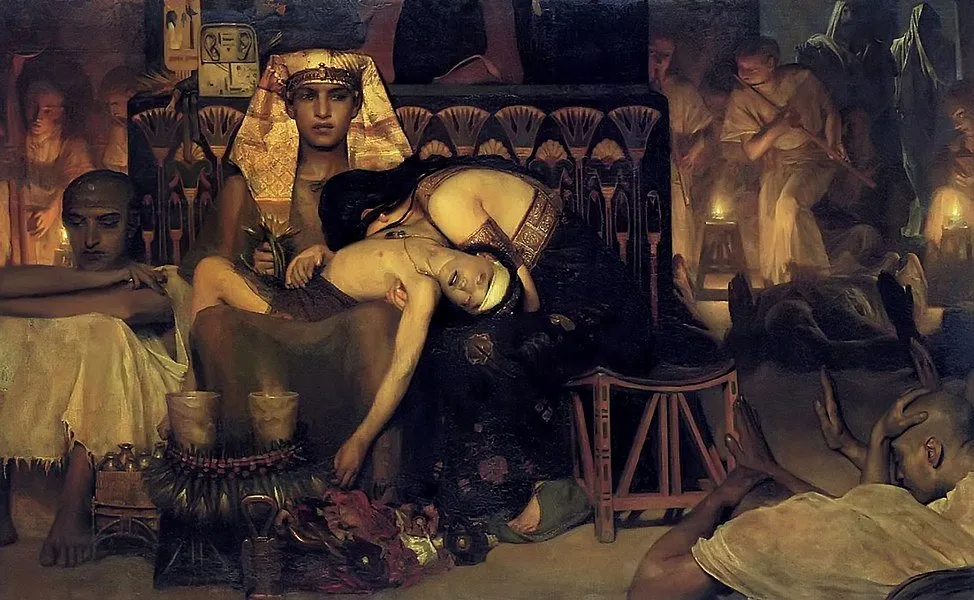
A dark Egyptian interior. A father holding his dead son. Silence so profound you can hear the lamp flame flicker.
The painting is called "The Death of the First-Born." And Alma Tadema painted it three times over forty-two years.
The Unexpected Favorite
In 1905, Percy Cross Standing published the first major biography of Alma Tadema. In it, he made a startling revelation:
"And, unexpectedly enough, this is understood to be the artist's own favourite work, and the one which he retains as his own possession."
Unexpectedly.
Why unexpected? Because this painting was the antithesis of everything the public loved about Alma Tadema.
It was not Roman. It was Egyptian.
It was not bright. It was dark, lit only by a single lamp.
It was not joyous. It was grief made visible.
It showed no marble terraces, no roses, no beautiful women in diaphanous silk. It showed a father holding his dead child.
And yet, this was the painting he loved most.
The Scene: Silence Made Visible
The subject is the tenth plague of Egypt—the night when the Angel of Death passed over the land and took every firstborn son.
In the dim interior of an Egyptian temple, Pharaoh sits on a low stool. Across his knees lies the slender body of his adolescent son. The boy's mother supports the body from the other side. Her face is a mask—no tears, no screaming, just monumental stillness.
Nearby, slaves crouch in the formal attitudes of Egyptian mourning. In the background, priests pray and musicians play instruments, but the music feels distant, muffled, as if heard through water.
Standing described it perfectly:
"The picture expresses silence, and the painter has avoided any demonstrative expression in the eyes of his sufferers. The colour is rich and low, and thus altogether an antithesis to the sweet brilliance of Mr. Alma-Tadema's habitual work."
This is not the Alma Tadema of sunlit gardens. This is the painter of grief.
Three Versions, Forty-Two Years
Most artists paint a subject once. Alma Tadema painted this scene three times:
1859 (Opus X): "The Sad Father"
He was twenty-three, unmarried, working in Antwerp. This was an academic exercise—painting grief he had not yet experienced.
1872 (Opus CIII): "The Death of the First-Born"
He was thirty-six, living in London. This was the masterpiece. This was the version he kept in his own possession. This was his favorite.
1901 (Opus CCCLXIV): A drawing
He was sixty-five. Twenty-nine years after the second version, he returned to the subject again. He could not let it go.
Why?
What was it about this dark Egyptian tragedy that haunted him for forty-two years?
The Paradox of the Favorite
The public loved Alma Tadema for his opulence. They loved the marble, the roses, the sunlight, the beautiful women. They loved "Spring" with its procession of flower-bearers. They loved "The Roses of Heliogabalus" with its avalanche of petals.
But he loved this.
A painting of a dead child.
The critic Monkhouse noted that "The Death of the First-Born" reached a "profounder depth of human pathos" than his usual work. It was not decoration. It was not spectacle. It was real human tragedy, painted with restraint and silence.
Alma Tadema himself, in an interview with the Strand Magazine, identified it as "one of his best works."
Not one of his most popular. Not one of his most profitable.
One of his best.
What the Favorite Reveals
Every artist has a favorite work. It is rarely the one that sells for the most money or hangs in the most famous museum. It is the one that shows their soul.
For Alma Tadema, that painting was "The Death of the First-Born."
It proved he could paint more than marble and roses. It proved he understood grief, restraint, and the terrible silence of loss. It proved he was not just a decorator of Victorian drawing rooms, but an artist who could touch the depths of human experience.
Standing wrote that the painting was "unexpected" as a favorite. But perhaps it was the most honest choice he ever made.
This was the painting that showed who he really was.
Not the painter of parties, but the painter of silence.
Not the painter of joy, but the painter of grief.
The Bequest
When Alma Tadema died in 1912, he bequeathed "The Death of the First-Born" to the Rijksmuseum in Amsterdam—his homeland.
He could have chosen "Spring." He could have chosen "The Roses of Heliogabalus." He could have chosen any of the bright, joyous paintings that made him famous.
But he chose this.
A father holding his dead son.
A painting of silence and grief.
The painting he loved most.
Continue the Journey:
Leave a Visiting Card
Consulting the visiting cards...