
The air in the Soho workshop of R. Dolman & Son is thick with the scent of freshly planed wood—not the common oak of the city, but the pale, ghost-like shimmer of sycamore. It is 1911, and London is suspended between two worlds. The Edwardian afternoon has faded with the passing of King Edward VII, and a new, uncertain Georgian era is beginning to stir.
In the center of the workbench lies a cabinet that is not quite a box and not yet a building. It is the Royal Academy’s "Address of Loyalty" to the new King, George V. But because it was designed by Sir Lawrence Alma-Tadema, it has become something far more visceral than a mere document, a final gift from the Royal Academy’s most devoted son.
The Material Palette of a Dreamer
Tadema did not merely choose wood for this commission; he summoned the textures of his own private sanctuary. The cabinet is a trinity of sycamore, holly, and ivory. To those who had stepped through the golden doors of his home at 17 Grove End Road, the choice was unmistakable.
Sycamore, with its rippled, "fiddle-back" grain, caught the light like sun-bleached marble. Holly provided a white so pure it seemed carved from light itself, while ivory offered the cool, solid weight of history. It was the same "archaeological" palette he had used for his legendary Steinway piano decades earlier.
At his side stood Thomas Maw, the man history sometimes misremembers as "Thomas Man." Maw was more than a carpenter; he was the ghost-joiner who had spent years translating Tadema’s impossible sketches into three-dimensional reality.
Diplomacy in Sycamore
To understand the cabinet, one must understand the "Address" it holds. In the rigid protocol of the British Empire, an Address of Loyalty is more than a card; it is a diplomatic instrument. It is the formal voice of an entire institution—the Royal Academy—offering its collective condolences for the death of a "Sovereign Lord" and its allegiance to a new one.
But why Tadema? The "Olympians" who had ruled the Academy in the previous century were long gone. Frederic Leighton, the golden-tongued president who seemed carved from the same marble he painted, had been in his grave for fifteen years. Millais and Watts were ghosts.
By 1911, Tadema was the last of the "Great Victorians" who still held a personal, living key to the Royal household. He had been a favorite of the late King and assisted with his coronation; he was the only artist with enough social gravity to bridge the two reigns. While the Academy's Secretary, Sir Frederick Eaton, drafted the formal prose of loyalty inside, Tadema was tasked with building the vessel that would carry it into the King’s presence.
It was a piece of "Diplomatic Architecture." By housing the words in sycamore and ivory, Tadema was signaling that under the new King, the Arts would remain as monumental and as permanent as they had been under the old.
A Door to the Gilded Age
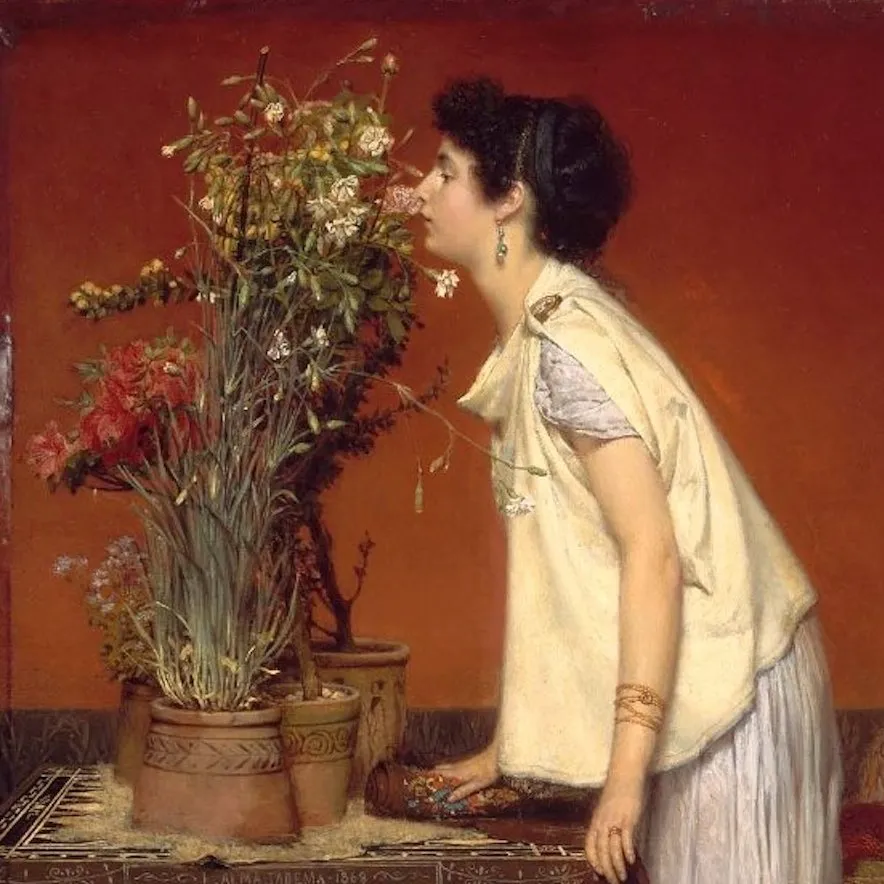
The object is designed with a hinged door, an invitation to enter the work. On the "outside leaf," a watercolor by Tadema depicts the Liberal Arts strewing flowers at the feet of the new Monarch. These are not merely allegorical figures; they are the voice of the Academy itself—Painting, Sculpture, and Architecture—offering the blossoms of a fading Spring.
There is a lingering resonance in those flowers. In the "Language of Flowers" Tadema knew so well, they serve a dual purpose: they are the celebratory strewing for a Coronation and the funerary petals for a lost "Sovereign Lord and Patron."
When the King finally opened that hinged door, he found the signatures of the entire British Art Establishment—Sargent, Poynter, Abbey, and Webb—waiting like guests in a hall. It was a snapshot of a golden generation, shivering slightly in the draft of the coming century.
The Echo of the Master
Tadema would not live to see the new King’s reign mature. He died in June 1912, just a year after the Sycamore Cabinet was presented.
Today, the cabinet rests in the Royal Collection, its sycamore grain still shimmering when the light hits it at the right angle. It remains a "Total Work of Art," a final, elegant bow from the man who spent a lifetime trying to prove that even the most fleeting of moments—a signature, a flower, a King's breath—could be held forever in the permanence of ivory and wood.
What remains is the silence of the cabinet, and the question of whether we, like the Liberal Arts, are still strewing flowers before the thrones of our own fleeting eras.
Leave a Visiting Card
Consulting the visiting cards...