
The dawn over the marketplace of Amphissa does not break with a shout. It arrives in silence, a pale, cool light that filters through the marble colonnades and spills across the limestone pavement like spilled milk.
But the agora is not empty.
Scattered across the stones, amidst the overturned baskets of honey-cakes and the silent stalls of produce, lies a sight that would freeze the heart of any citizen in the year 350 BC.
The Thyiades have arrived.
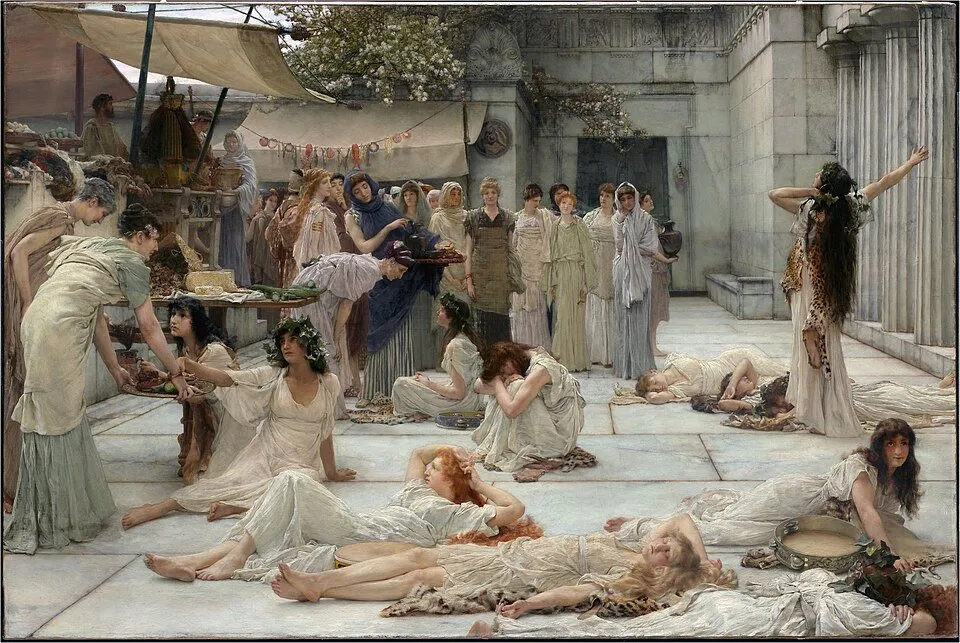
The Night of the Frenzy
To understand this moment, one must understand the night that preceded it.
The Thyiades were the priestesses of Dionysos, a select group of women drawn from both Delphi and Athens who would meet every two years in a grand, unified sisterhood. They abandoned the structured safety of their homes to climb the treacherous, snow-choked heights of Mount Parnassos. In the absolute dark of winter, they performed the oreibasia—a ritual mountain-dance. They were mainomenoi—not insane in the way we understand the word today, but "spirit-possessed," their identities momentarily eclipsed by the divine energy of their god.
The danger was not merely spiritual; it was visceral. History tells of rescue teams being sent into the peaks to find Thyiades who had become stranded or frozen by sudden snowstorms. The mountain did not forgive.
But on this particular night, the air was thick with more than just incense and cold. The Third Sacred War was raging (c. 350 BC), and the borders between city-states were bleeding with conflict.
Disoriented by their own ecstatic dance and the shifting shadows of a country at war, the priestesses wandered ten miles west of Delphi. They stumbled into Amphissa—an enemy city, a place where they were technically invaders, vulnerable to the whim of any passing soldier or suspicious citizen.
When the frenzy finally broke, they didn't have the strength to return. They simply collapsed. They fell where they stood, their bodies sprawling across the limestone pavement of the marketplace like broken dolls, exhausted and entirely at the mercy of strangers.
The Silent Sentinel: The Half-Circle Composition
In the ancient world, a group of vulnerable, "mad" women collapsing in a city full of enemy soldiers was a recipe for catastrophe. The Greek playwright Euripides had already warned of the terrifying power of these women when they were in their trance—he told stories of them dismembering herds with their bare hands. Yet, in their sleep, they were merely prey.
But before the soldiers could stir, the women of Amphissa moved.
They did not call for their husbands to handle the intruders. They did not wait for the law. They walked into the marketplace, gathered their robes, and formed a protective circle.
Alma-Tadema captures this transaction of grace with a clarity that feels almost like a high-definition photograph. But his most significant choice is the way he has constructed the perspective. He hasn't painted a closed circle of women. Instead, he has left a gap in the foreground—a "half-circle" that effectively positions the viewer within the scene.
By leaving this visual opening, the artist invites the viewer to stand as the final sentinel in the guard. We are not merely spectators looking at a historical anecdote; we are positioned as part of the circle protecting the sleepers.
At the center of it all, one woman stares back with a level, unflinching gaze. It is a recognizable portrait of Laura Alma-Tadema, the artist’s wife and a brilliant painter in her own right. By casting her as the chief matron, Lawrence makes her the "hostess" of the sanctuary, her direct gaze engaging the viewer in the shared responsibility of the watch.
A Conversation of Textures: The 'Sleeping Ariadne'
The power of this masterpiece lies in the sensory contrast between the two types of women. It is a conversation between those who have just returned from the wild and those who have never left the hearth.
Notice the Thyiades on the ground. They are disheveled—their hair is uncombed, their feet are unwashed from the ten-mile trek through the mountain dust and sharp stones. They wear the "wild" costumes of the mountain: the rough skins of fawns and panthers, ivy vines braided into their tangled curls, and their tambourines lying silent and battered beside them. They represent the untamed instinct of the soul—the part of us that wanders into the heights.
Alma-Tadema was likely influenced by his friend Frederick Leighton’s famous painting of the Sleeping Ariadne. But where Leighton’s woman was a figure of tragic desertion, Alma-Tadema’s priestesses are figures of sisterly recovery.
Their limbs are sprawled in patterns of deep exhaustion, yet they possess a visual alertness—reminiscent of the famous ancient statue of the Barbarini Faun. Even in sleep, they do not look entirely at peace; they look as if they might bolt or strike if an unfamiliar hand touched them. They embody what the poet Walter Pater called the "Spirit of Fire"—the heat of the dance—now cooled by the "Spirit of Dew," the soft moisture of the morning.
The Artifacts of a Sanctuary: A 'Frankenstein' of History
Alma-Tadema’s obsession with historical detail is legendary, but for him, it was never just about showing off. Every object was chosen to build the "vibe" of the sanctuary.
The carved panels you see above the doorway are modeled on the ancient ruins of Temple E at Selinus in Sicily. Lawrence had sketched them during his own honeymoon travels decades earlier. The fountain is a masterwork of creative "remixing"—he meticulously reconstructed it from two different statues he found in the Vatican collection.
Even the marketplace stalls are a sensory delight for those who love still-life painting. They are brimming with the sights and smells of the ancient world: pots of golden honey, jars of oil, game hanging from hooks, and the delicate weave of wicker baskets. It is as if the artist is saying that even in the midst of a religious "hangover," the simple business of life—the act of providing food and shelter—is a sacred thing.
The light itself tells the final story. This is not the first pale flush of dawn; it is the diffuse, sober light of a "late morning." The night of the frenzy is truly over. The world is waking up, and the women of Amphissa are waiting for the exact second when the "divine madness" fades into simple, human hunger.
The Beer Tycoon and the Prize of Paris
In 1889, this painting was sent to the Paris Exposition Universelle. It was the Olympics of the art world, a battlefield where the finest painters in Europe competed for glory.
Against the giants of French art, Alma-Tadema’s vision of female bravery won the Gold Medal of Honor. It was the moment he became an international superstar. The French critics, who were usually very protective of their own classical style, were mesmerized by how he made cold marble look warm and how he made "sisterhood" look as heroic as any battle.
The painting’s journey to the public was fueled by "New Money." It was first purchased by Daniel Thwaites, a wealthy beer brewer from Lancashire. Thwaites was a self-made man who loved the order and precision of Alma-Tadema's work—it reflected the discipline of his own industrial empire. From a brewery in the north of England to the heights of the Paris art scene, the painting eventually found its way across the Atlantic.
In 1978, it was acquired by the Clark Art Institute in Williamstown, Massachusetts. Today, it remains one of the few massive Alma-Tadema masterpieces that anyone can walk in and see for free (or the price of museum admission), standing as a permanent bridge between Victorian England and Ancient Greece.
The Echo of the Morning
The painting does not show the ending of the story.
Plutarch tells us that when the priestesses finally woke up, the women of Amphissa did more than just watch. They fed them, helped them clean their tangled hair, and then—having secured permission from their husbands—personally escorted them to the frontier. They walked with them, mile after mile, until they reached the safe borders of Delphi.
It was a triumph of sisterhood over the politics of war. If you look closely, you will see only one male figure in the entire painting—a tiny, barely visible soldier in the deep background. This is a woman’s world.
The painting functions as a radical story of civic empathy. It suggests that a "sanctuary" is not just a building; it is a circle formed by people who choose to be brave. It suggests that even those who have lost themselves in the "madness" of the mountain deserve the protection of those who stayed at home.
As one looks at the cool shimmer of the marble and the soft, breathing forms of the priestesses, the power of the composition becomes clear. It is a reminder that beauty is not just a decoration on a wall.
Sometimes, it is a shield.
Sometimes, in the marketplace of life, the most significant act of courage is the willingness to stand in the circle and wait for the light to return.
Sources & Further Reading
- Hedreen, Guy. "Sir Lawrence Alma-Tadema's 'Women of Amphissa'." The Journal of the Walters Art Gallery, Vol. 52/53 (1994/1995), pp. 79-92. Stable URL.
- Plutarch. Moralia: Mulierum Virtutes (The Bravery of Women), XIII.
- Moser, Stephanie. Painting Antiquity: Ancient Egypt in the Art of Lawrence Alma-Tadema. (2020).
Leave a Visiting Card
Consulting the visiting cards...