
The air in Wittersham is different from the marble hush of her father’s studio.
Here, in the rolling green of Kent, the scent of the sea mixes with the smell of fresh-cut pine. Far from the cigar smoke and the elite "Hall of Panels" in London, Laurence Alma-Tadema built a theatre of her own.
She called it "The Hall of Happy Hours."
It was a small, wooden structure, designed to hold exactly one hundred souls. In this space, the eldest daughter of the Great Sir Lawrence was neither a muse nor a secretary. She was the architect of an atmosphere.
While her father painted the cold, immortal texture of stones, Laurence was capturing the fleeting resonance of the voice.
The Poem That Refused to Marry
In 1897, Laurence published a collection titled Realms of Unknown Kings. It was a serious, almost somber volume, but hidden within its pages was a piece of deceptive simplicity: "If No One Ever Marries Me."
On the surface, it is a nursery rhyme. A child’s whimsical blueprint for a life lived alone.
But if you linger on the words, knowing Laurence’s own history of independence and her refusal to follow the traditional Victorian path, the poem begins to hum with a different frequency.
If no one ever marries me,
And I don't see why they should;
For nurse says I'm not pretty,
And I'm seldom very good—
If no one ever marries me
I shan't mind very much;
I shall buy a squirrel in a cage,
And a little rabbit-hutch:
It is a declaration of autonomy disguised as a lullaby. The narrator does not mourn the absence of a husband; she plans a kingdom of squirrels, ponies, and tame lambs. She constructs a world where happiness is self-authored, not bestowed.
The Art of the Song
The verses soon reached Liza Lehmann, the most formidable female composer of the Edwardian era. Lehmann did not treat the poem as a simple folk tune. She set it within her masterwork, The Daisy Chain (1900), transforming the fragile lines into a demanding "art song."
It required the discipline of an opera singer to navigate its playfulness. In the drawing rooms of London, the song became a sensation—a refined, sophisticated echo of the nursery that whispered of a woman’s right to choose her own company.
A Modern Resonance
The power of a quiet voice is that it never truly fades.
A century after the first performance, the American singer Natalie Merchant rediscovered Laurence’s words for her album Leave Your Sleep. Merchant stripped away the operatic ornament and returned the poem to the earth.
In this modern interpretation, the song feels like a secret shared across time. It reminds us that the dream of a "cottage near a wood"—a life defined by peace rather than possession—is a timeless human hunger.
The Shadow Behind the Sound
When The Daisy Chain was echoing through the concert halls, Laurence was thirty-five years old. The poem was not a child's fantasy; it was a woman’s reality.
Behind the whimsy lay the physical and emotional weight of her life. In the very year the song was celebrated, her father noted in a letter that Laurence had "hurt her hand in a guillotine window."
It is a visceral image—the crushing of the hand that held the pen. It serves as a reminder that her "Hall of Happy Hours" was not a place of idle play, but a hard-won sanctuary carved out of a world that could be physically and emotionally bruising.
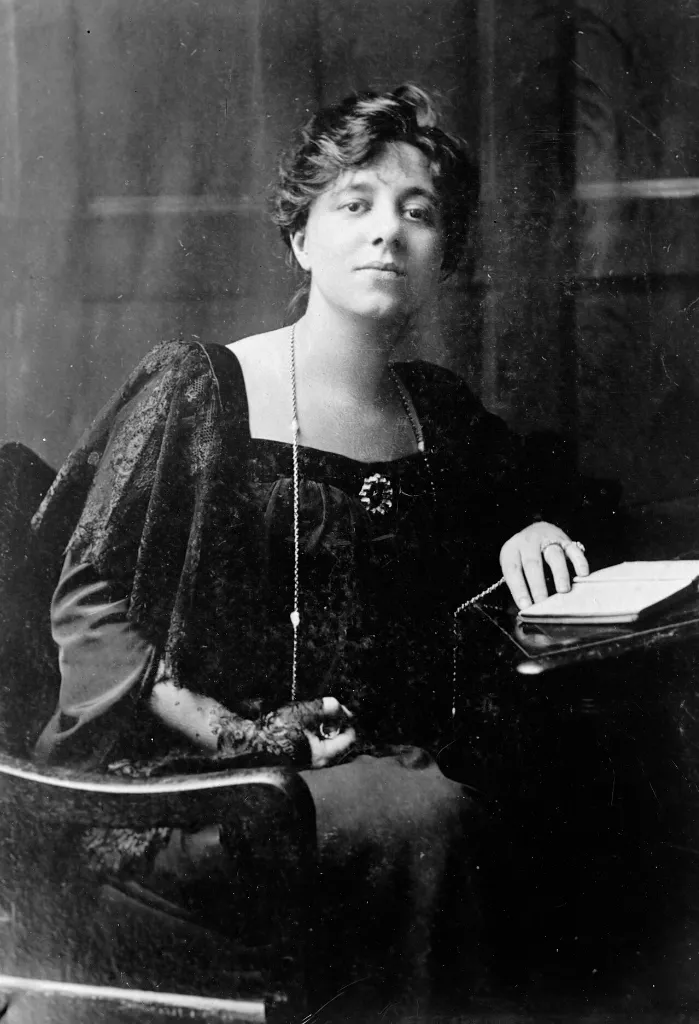
Laurence never did marry. She never did buy that squirrel in a cage. Instead, she spent the rest of her life ensuring that voices other than her own were heard—becoming a champion for the cause of a distant nation.
But here, in the silence of the Wittersham theatre, the song remains.
It is a reminder that while her father built a palace of marble to the past, Laurence built a house of wood and air for the heart.
Leave a Visiting Card
Consulting the visiting cards...