
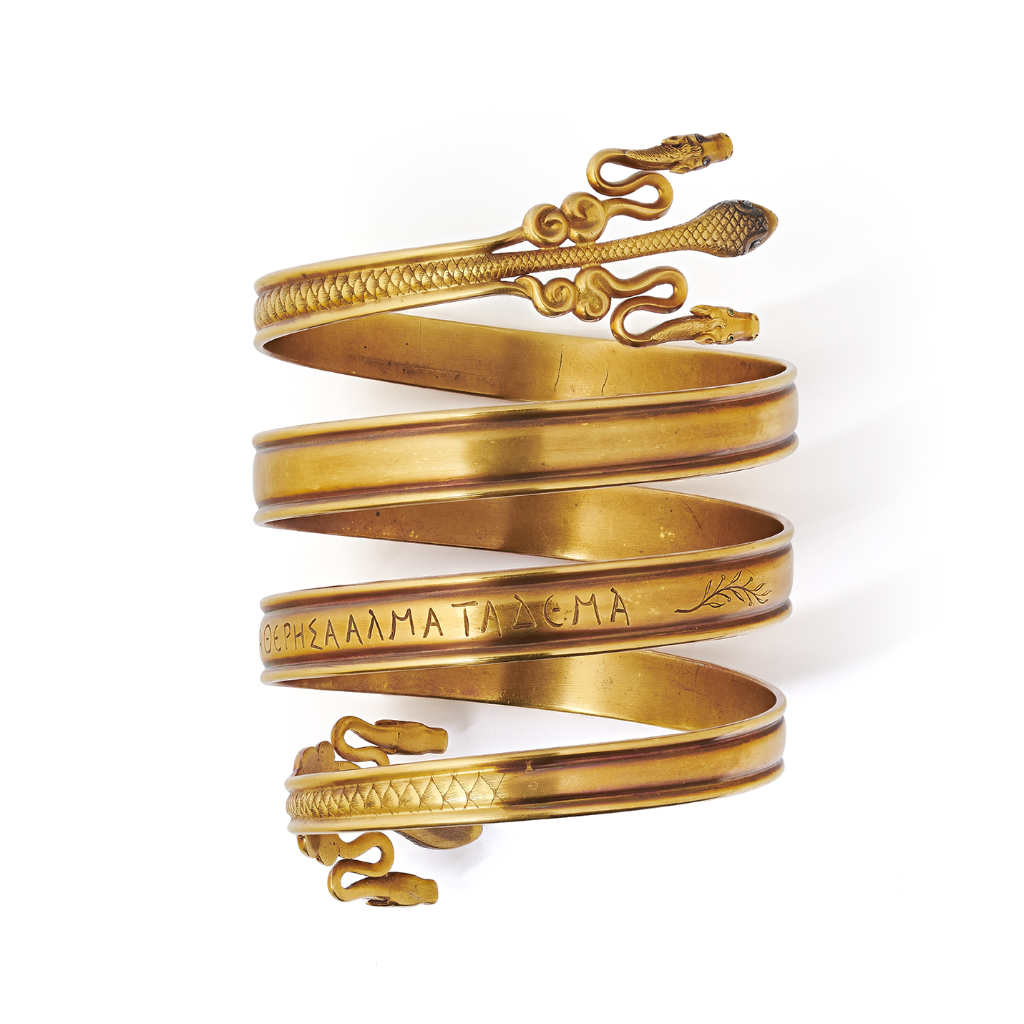
To hold this armlet is to feel the weight of history.
Most jewelry today is designed to be light and delicate, barely sitting on the skin. But the gold armlet Sir Lawrence Alma-Tadema made for his wife, Laura, was built to last. It weighs nearly a pound (406 grams)—hold a standard bag of sugar in your palm, and you will begin to understand the physical reality of this gift. It isn't just a piece of jewelry; it is a heavy golden anchor that tied Tadema's imaginary Roman world to his real life at home.
Created between 1871 and 1873, in the first years of their marriage, the armlet shows the two things Tadema loved most: his wife, who was his constant model, and the ancient mysteries of Pompeii. It was more than a gift; it was a curated piece of history, designed to replace a dusty bronze artifact with a gleaming promise of gold.
The Detail of a Coin-Maker
Tadema was obsessed with accuracy. He was the kind of painter who would measure the space between Roman floor tiles with a ruler. When he wanted to make this special gift, he didn't go to a regular jeweler. Instead, he went to the firm of J.S. & A.B. Wyon, led by the brothers Joseph Shepherd Wyon (1836–1873) and Alfred Benjamin Wyon (1837–1884).
The Wyons weren't known for making necklaces; they were the Chief Engravers of the Queen’s Seals. They were the experts who carved the metal stamps used for coins, medals, and royal documents. Tadema chose them specifically for their mastery of metal engraving. He didn't want the "soft" look of a boutique jeweler; he wanted the scales of the snake and the Greek letters to have the razor-sharp authority of a newly minted gold coin.
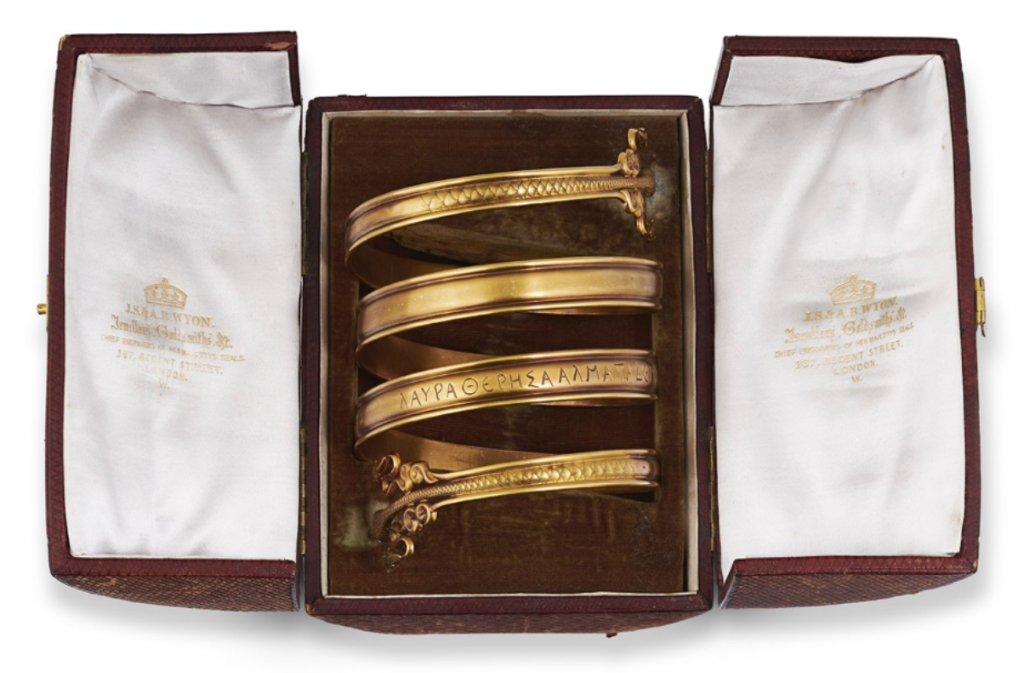
The relation was professional but also deeply personal. The jewel was delivered in a custom leather-covered box, where the lid's silk lining is stamped with the Wyon name surmounted by the Imperial Crown.
A letter survives, dated March 6, 1873, in which Tadema invites Joseph Wyon to a dinner for the Artists' General Benevolent Institution. He asks Wyon to sit at his table and "subscribe to my list."
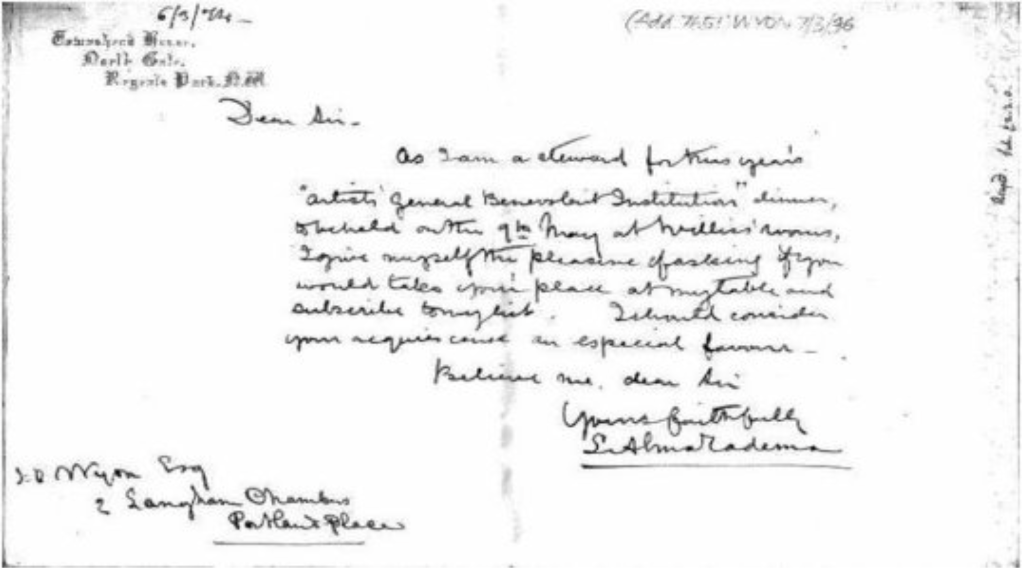
Dear Sir — As I am a steward for this year's 'Artists' General Benevolent Institution' dinner, to be held on the 9th May at Willis's Rooms, I give myself the pleasure of asking if you would take your place at my table and subscribe to my list. I should consider your acquiescence an especial favour. Believe me, dear Sir — Yours faithfully, L Alma Tadema."
Joseph Shepherd Wyon (Chief Engraver of Seals) and his brother Alfred Benjamin Wyon were both students of the Royal Academy, which is likely where they met Tadema. The armlet represents a rare departure for their firm—a piece of "sculpture for the body" that moved beyond their usual repertoire of medals and seals.
Tragically, the armlet was one of Joseph Shepherd Wyon's final finished masterpieces. He died at Winchester on August 12, 1873, just as the piece was complete and making its debut in Tadema's paintings. Following his death, Alfred took over the post of Chief Engraver, continuing the family legacy that had served the Crown for generations.
The Etruscan Craze
To understand why Tadema made this armlet, you need to understand the jewelry world of the 1860s and 70s. Europe was in the grip of an "Archaeological Revival" movement. It had begun decades earlier when the Princess of Canino dazzled Roman society by wearing actual Etruscan gold found on her own estates. By the time Tadema was a young man, this "excavated" look was the height of fashion.
The movement centered on one man: Alessandro Castellani. He was a Roman jeweler who exhibited Etruscan-style pieces at the 1862 International Exhibition in London. The response was explosive. By 1867, nearly every jeweler's showcase in Paris was filled with "archaeological" designs. In London, the satirical magazine Punch mocked wealthy ladies for buying so much Etruscan jewelry from Castellani's shop that they were "weighed down" by it.
One of Castellani's associates, Carlo Giuliano, became the movement's London star. His shop at 115 Piccadilly was very close to the Royal Academy. Giuliano was famous for a specific pendant design taken from an ancient jewel in the Louvre, and Tadema loved it so much he painted variations of it into three of his works.
But when it came time to make the armlet for Laura, Tadema didn't go to Giuliano.
He went to the Wyons. Why? Because Tadema didn't want fashion—he wanted precision. The Wyons were seal engravers, not jewelers. Their work had the sharpness of a coin, not the softness of a boutique piece. And their shop was on Regent Street, which Tadema passed every day on his walk from Regent's Park to the Royal Academy.
The multi-coil snake bracelet was the most popular item of the Archaeological Revival. Tadema was commissioning the ultimate version of the hottest trend of his era—but with the accuracy of a museum curator.
Inspired by Ancient Ruins
The design wasn't just made up. It was a direct response to a discovery in the ruins of Cumae, Italy. In 1872, a large bronze spiral armlet with triple animal head terminals (Reference: BM 1872,0604.686) was purchased by the British Museum from Alessandro Castellani.
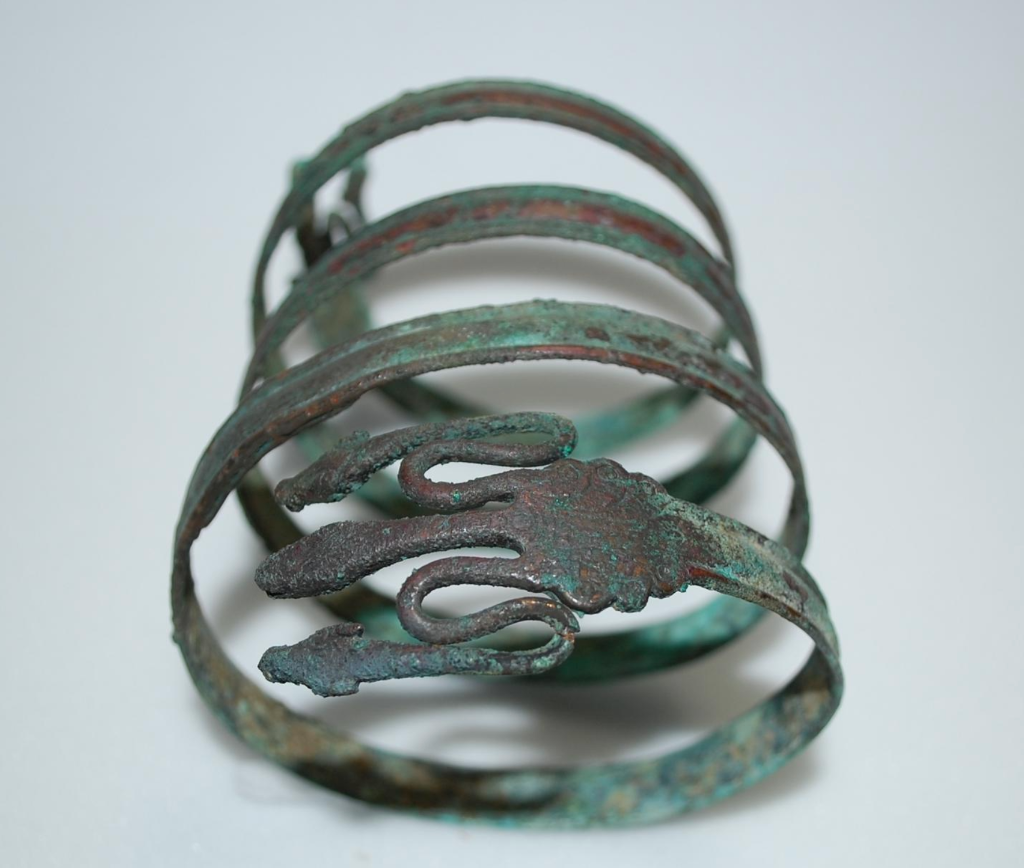
This specific prototype was identified by Sarah Kilroy of the University of Birmingham. Tadema, who spent hours in the museum studying ancient objects, would have handled that original bronze piece at the exact moment he was courting Laura.
In the 4th century BC, the Lucanians were a powerful tribal people who loved bold, colorful gold. While Greek jewelry was often elegant and simple, Lucanian pieces were heavier and more "royal," designed to show wealth and warrior-class status. The horse was their ultimate symbol of nobility. By adding these horse heads, Tadema wasn't just making a Greek bracelet—he was creating a piece fit for a queen.
But the most touching detail is the name carved into the gold in perfect Greek letters:
(Laura Theresa Alma Tadema)
By giving her this gift, Tadema turned his Victorian wife into a timeless Greek figure. Every time she wore it, she stepped out of London and into the ancient world he painted.
The Secrets of the Inscription
The way the name is carved into the gold reveals Tadema’s obsession with what historians call Epigraphy—the study of ancient inscriptions. It wasn't enough to use Greek; he wanted the style of the letters to match the archaeology:
- Epigraphic Style (All Caps): Ancient Greeks didn't use lowercase letters or decorative accents. They wrote in Majuscule (all-caps), especially when carving into hard surfaces. By using this "primitive" look, Tadema ensured the armlet felt like a genuine artifact dug out of the earth, not a Victorian trinket.
- The Triangular Delta (Δ): Note the "D" in Tadema. In lowercase, it is a loop (δ), but in the monumental inscriptions of ancient Greece, it is a perfect triangle. Stone-carvers and coin-engravers found straight lines easier to cut than curves—Tadema preserved this technical detail to give the piece "archaeological authority."
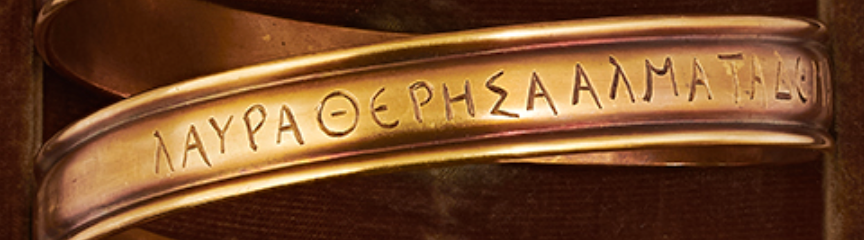
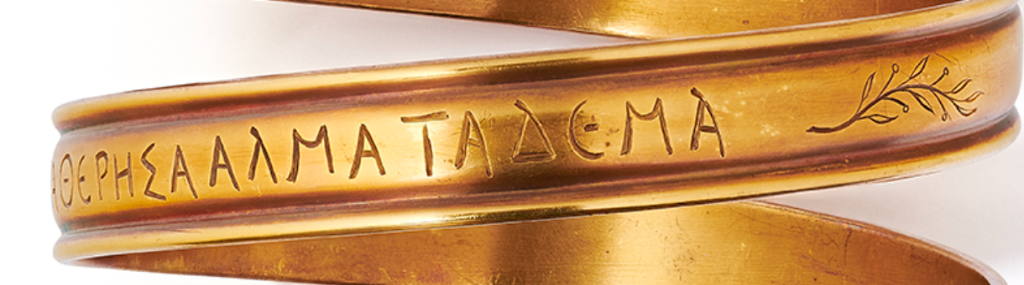
- Archaic Spelling (ΘΕΡΗΣΑ): The standard Greek for Theresa is Θηρεσία (Thēresia). However, the armlet uses ΘΕΡΗΣΑ (Therēsa), a more phonetic, archaic rendering. It is shorter, sharper, and feels like a greeting from a different era.
- The Wyon Factor: This is where the choice of jeweler becomes crucial. The Wyon Brothers were coin-makers, not boutique jewelers. They spent their lives carving steel dies for the Royal Mint. They were the world's leading experts in the sharp, "punched" style of Roman coins. Tadema almost certainly told them: "Don’t make it look like a book; make it look like a newly minted coin from the age of Augustus."
The inclusion of the blossom branch at the end acts as a signature "Tadema" flourish—a soft, organic ending to a hard statement of historical fact.
A Living Work of Art
It would be a mistake to think this gold snake was only a "prop" locked in a studio drawer between paintings. Laura Theresa was one of the most famous hostesses in London. The Tadema home—first Townshend House and later 17 Grove End Road—was a social stage. Their "At Home" Tuesday evenings and musical concerts were attended by the elite of the Victorian world.
When guests entered the house, they weren't just visiting a friend; they were stepping into a Roman villa in the middle of London. Laura was the living center of that world. While we often think of Victorians as "uptight," formal evening etiquette was the one place where bare arms were allowed—and even required. During the Tademas' famous "At Home" musical evenings, Laura would have followed the custom of removing her long evening gloves for dinner, leaving her arms as a bare canvas for the heavy gold.
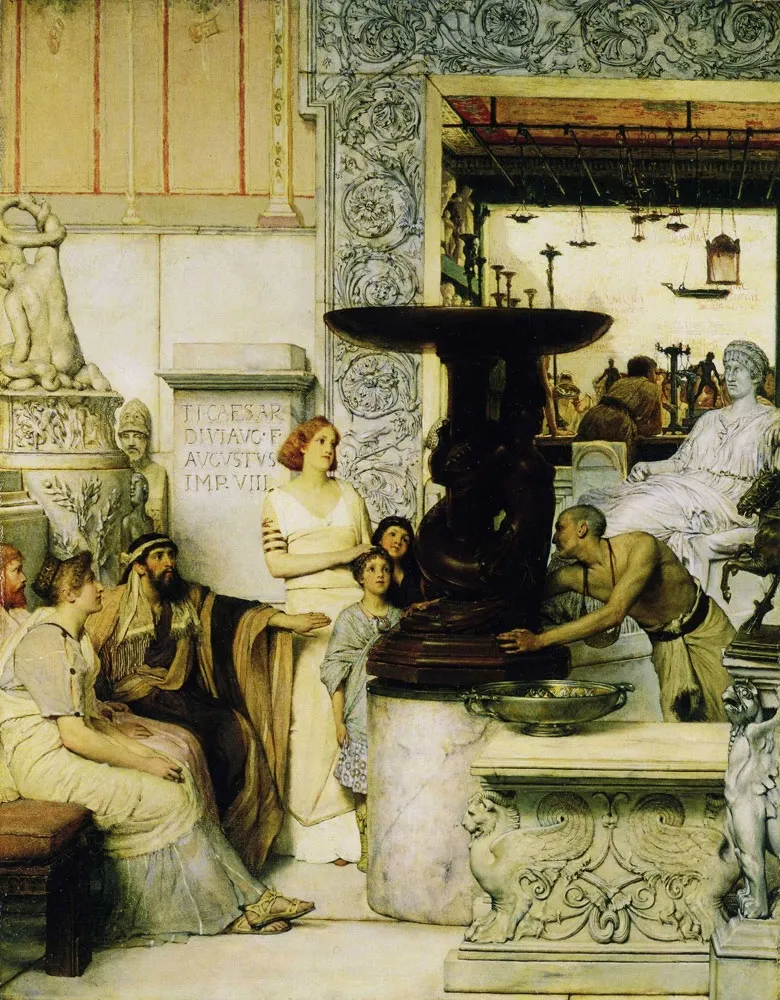
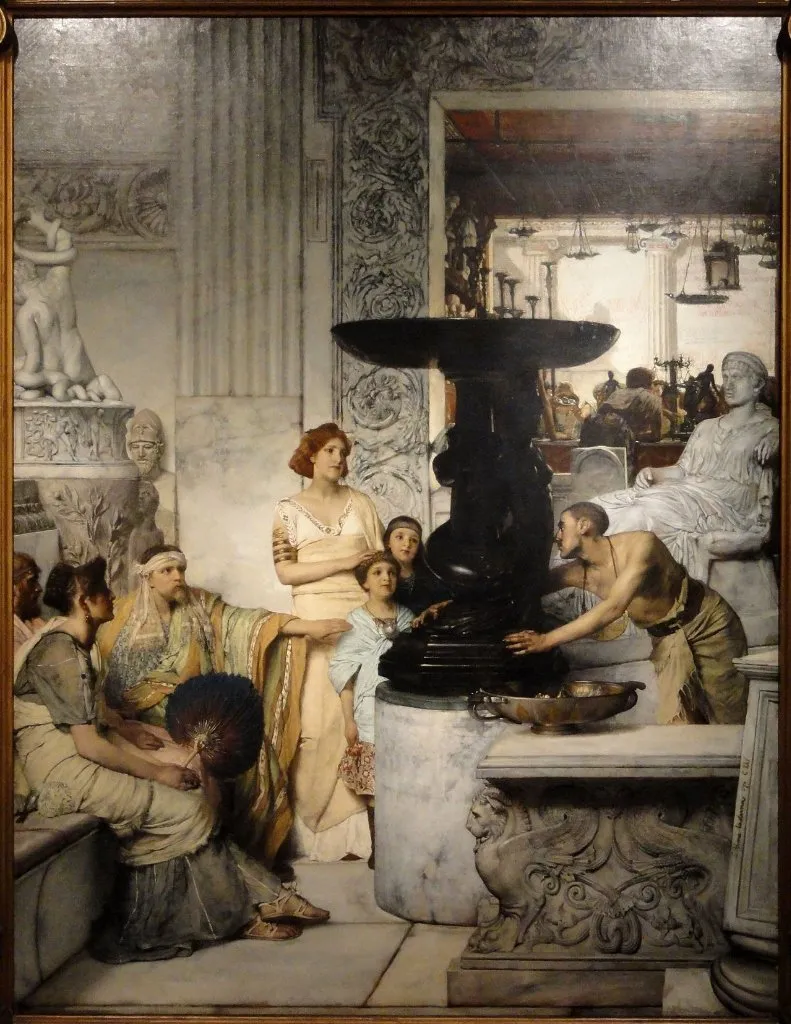
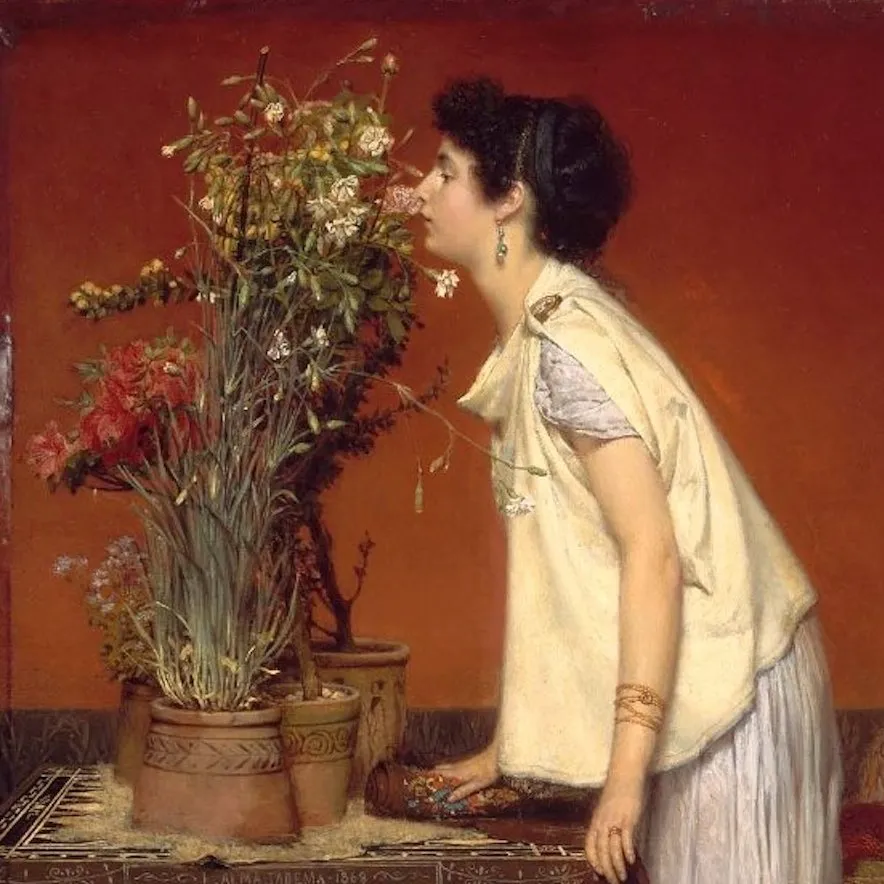
Her personal style was an inspiration to the emerging Artistic Dress movement. By favoring flowing, "Grecian" gowns over the stiff, high-collared corsets of the day, Laura became the physical embodiment of her husband’s art. One can imagine her wearing the coiling serpent at a social gathering—not just as a fashion statement, but as a signal that she and Lawrence lived by their own rules, inside an "ancient dream" that the rest of London could only see on the walls of the Royal Academy.
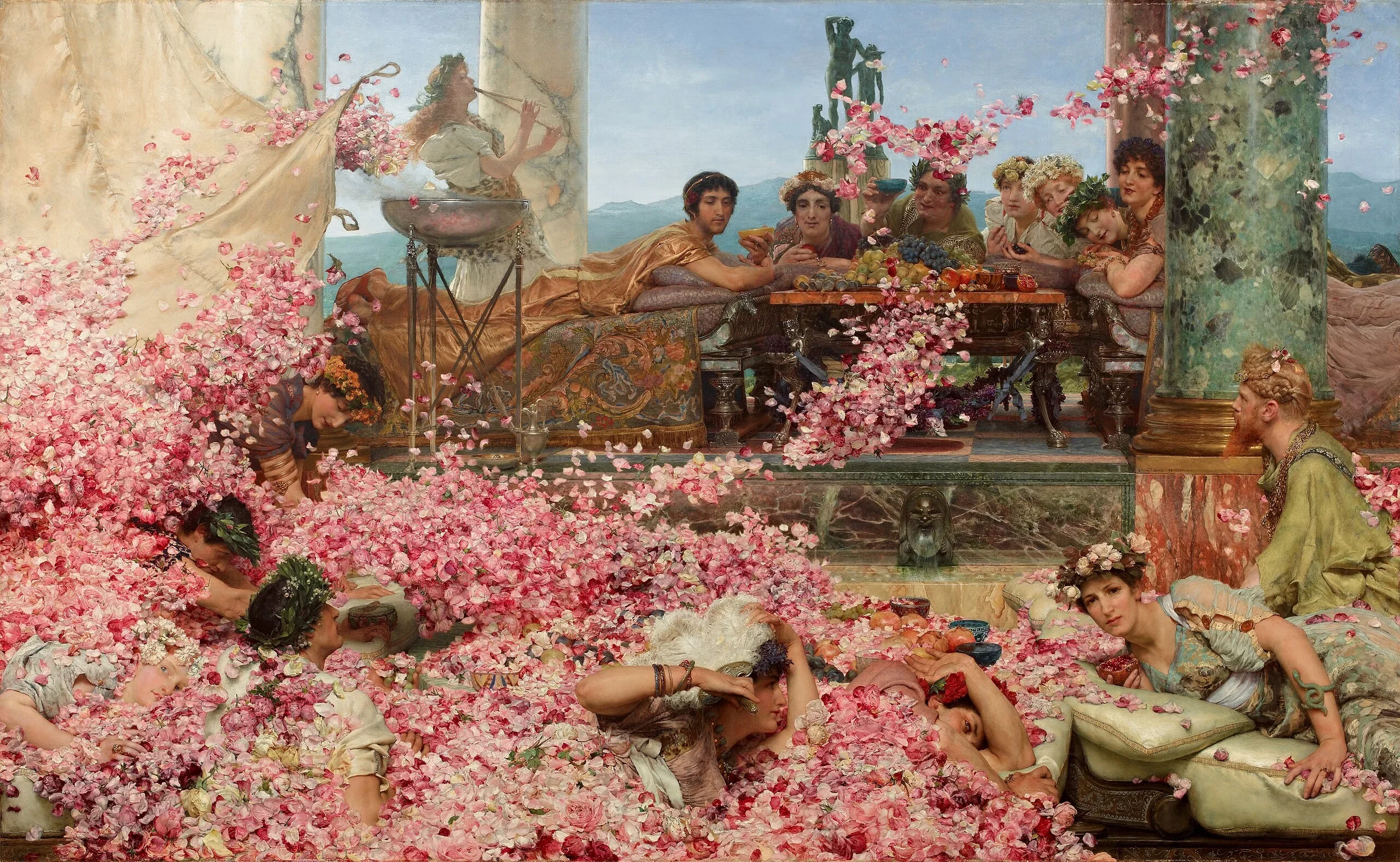
Tadema was one of the first artists to bring this "snake style" back into fashion. This coiling gold design actually appeared decades before the famous Bulgari Serpenti collections that celebrities love today. Long before modern fashion houses looked to Rome for inspiration, Tadema had already brought those golden serpents back to life in his London studio.
The Snake as Protector
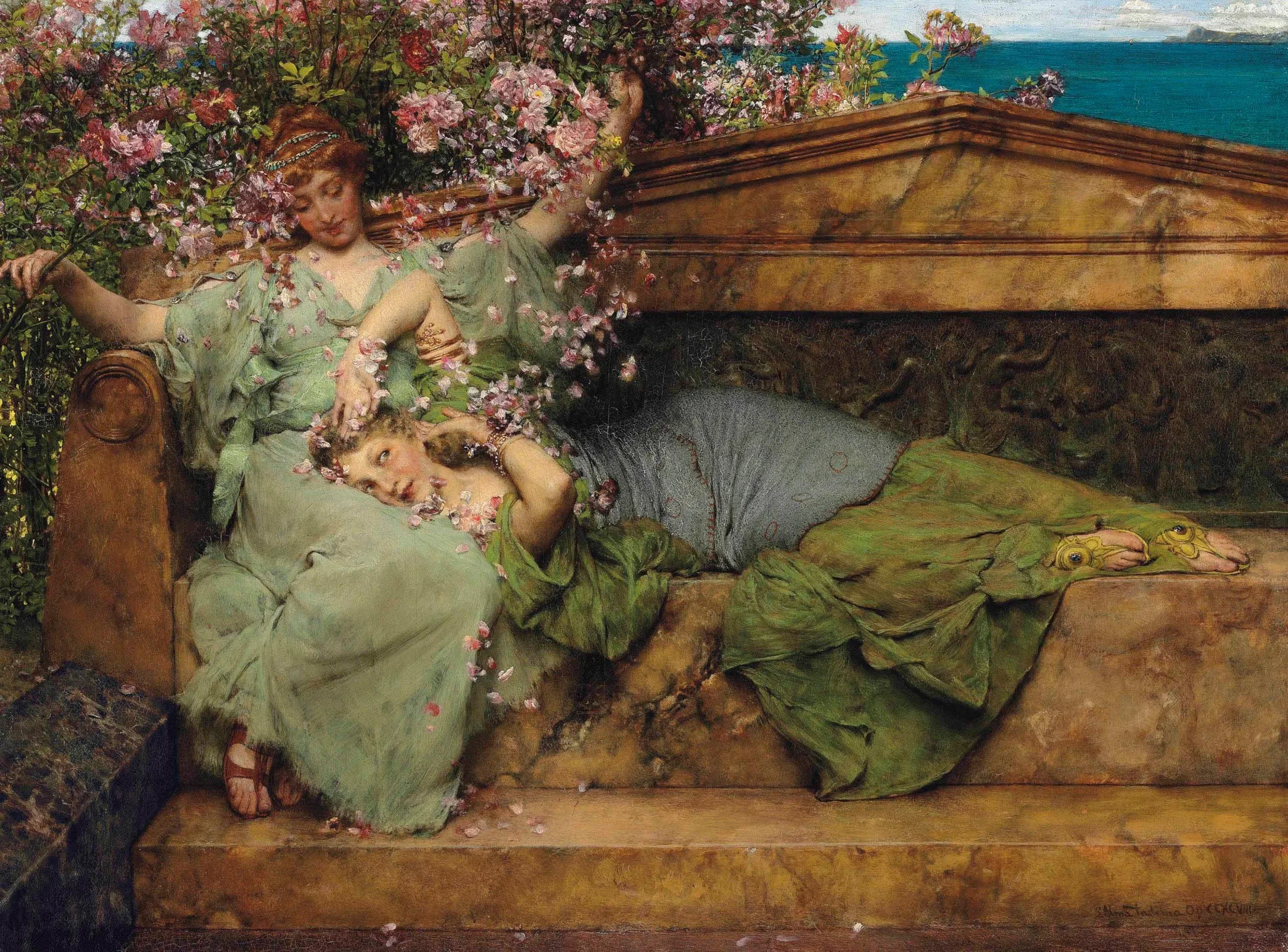
To the people of ancient Rome, the snake wasn't a symbol of evil. It was the "Good Spirit" of the house, a protector that looked after the family.
The Golden Legacy
One of the most revealing details about the armlet's value to the family is its absence. After Sir Lawrence died in 1912, his house and its vast collection of treasures were auctioned off in a famous sale by Hampton & Sons in June 1913. While 1,511 objects—Roman artifacts, furniture, and studio props—were sold to the highest bidder, the armlet was nowhere on the list.
It was likely exempted as a "personal effect" and passed directly to his daughters, Laurence and Anna. It wasn't a piece of property to be traded; it was a family member.
The French Hallmark and the Lost Decades
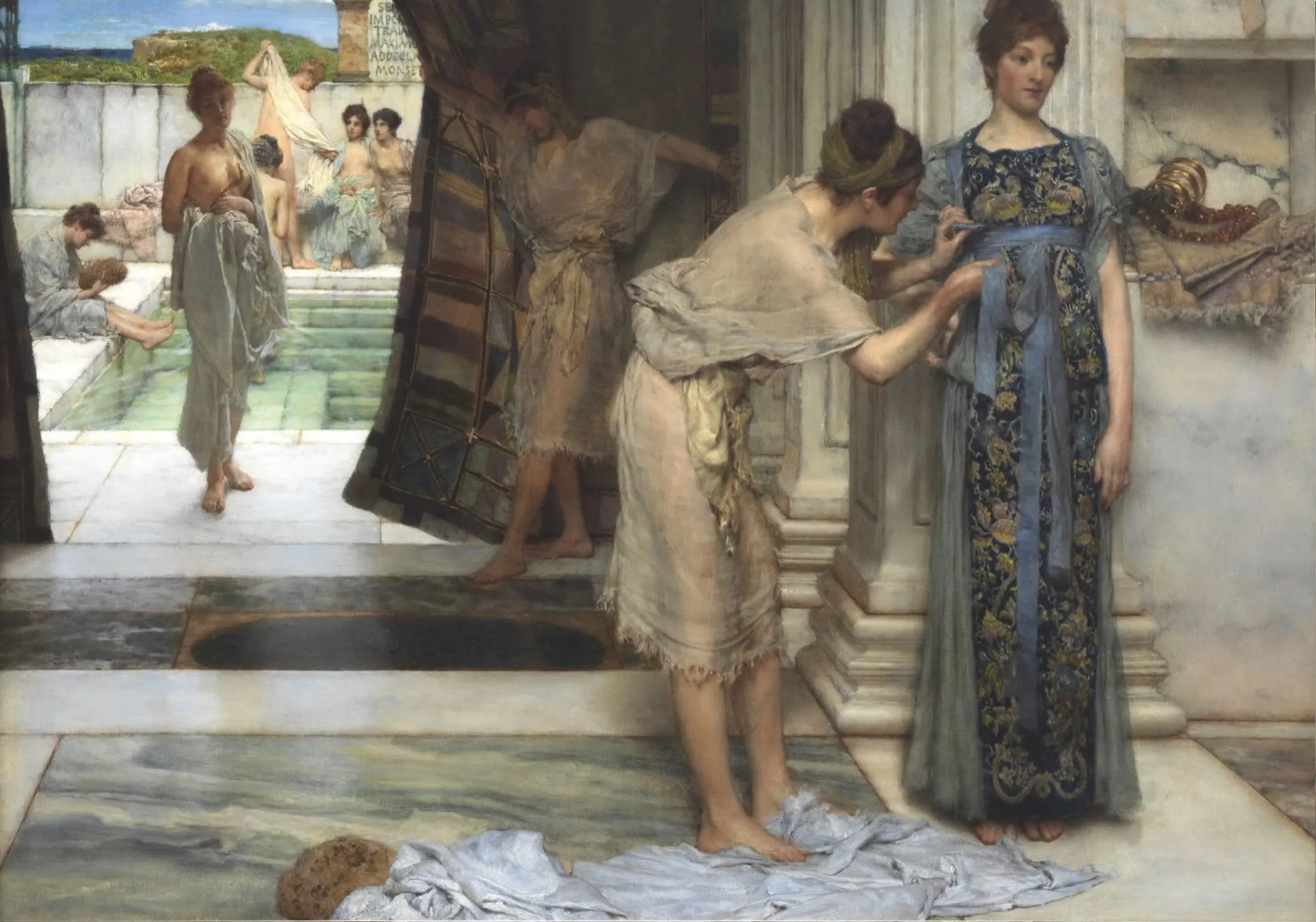
After Laura's death in 1909, the armlet passed to Laurence Alma-Tadema. When Laurence died in 1940, her possessions were in her Paris apartment. The armlet's journey through the war years remains partly mysterious, but one clue survives: the French assay mark.
Stamped into the gold is the hibou (owl), the official hallmark of the French assay office certifying it as 18-carat gold. This mark was likely added sometime between 1944 and 1950, when the armlet passed through a Parisian dealer or auction house after the Liberation. Only registered jewelers and auctioneers could apply for this hallmark, confirming the piece had entered the legal market.
From the early 1950s until 2006, the armlet remained with a single Parisian family—over half a century in quiet, private hands. Then, in November 2006, it was sold to an antique shop, where researcher and collector Jeff Cadby found it and immediately recognized its significance.
The Royal Custodians
Today, the armlet resides at Wartski, one of the most prestigious jewelers in the world. Located on St James's Street in London, Wartski holds Royal Warrants as jewelers to King Charles III and Queen Camilla. They are the same firm that made the wedding rings for Prince William and Catherine, and they are the world's leading experts on Fabergé, having acquired Imperial Easter Eggs from the Soviet government in the 1920s.
For the Tadema Armlet to be in Wartski's care is the ultimate validation. It is no longer just "Victorian jewelry"—it has been elevated to the status of a national treasure, placed alongside Fabergé eggs and royal commissions. It confirms what Tadema always knew: this was never just a bracelet. It was a monument in gold.
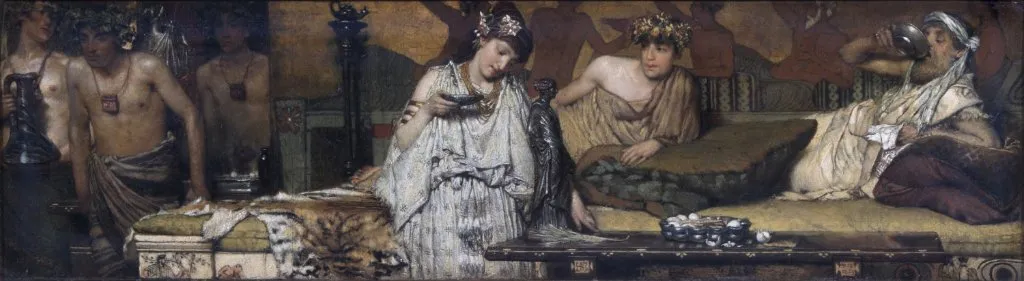
The armlet remains a rare bridge between Tadema's paintings and his reality. When you look at his famous painting, The Roses of Heliogabalus, look past the petals. Look at the woman on the left. Look at her arm.
The gold is still there. It has survived wars and time, a solid reminder of a husband's love and an artist's obsession with the light of the ancient world.
Reflections
We are indebted to the research of Jeff Cadby, who identified the true significance of the Alma-Tadema Armlet and tracked its modern provenance from the archives of Paris. His definitive study can be found on Academia.edu. We also thank Sarah Kilroy of the University of Birmingham for her identification of the British Museum prototype.
Leave a Visiting Card
Consulting the visiting cards...