
The sun is setting over the Forum. The business of the day—the shouting in the courts, the haggling in the market—is done. In Rome, the clocks did not mark time by hours, but by water. And when the late afternoon sun hit the marble, every citizen knew: it was time to bathe.
This was not a quick shower. It was a daily Roman bathing ritual that could consume the entire afternoon—a journey through heat, cold, oil, and conversation that defined what it meant to be Roman. To step into the baths was to step out of the chaotic city and into a world of curated sensations.
Why did it take so long? Because the "bath" was merely the finale. The Roman bathing ritual began with exercise in the Palaestra (wrestling or ball games to work up a sweat), followed by a slow migration through the rising heat of the Tepidarium and Caldarium. Then came the vigorous "scraping" (strigiling), distinct from washing, followed by massages and oiling. And in the pauses between these physical acts, the real business of Rome happened: socializing, networking, or reading in the complex's vast libraries.
Sir Lawrence Alma-Tadema knew this ritual better than any modern historian. He didn't just paint the walls; he painted the feeling of the steam. Through his eyes, we can walk through the sequence ourselves.
I. The Apodyterium: The Striptease of Status
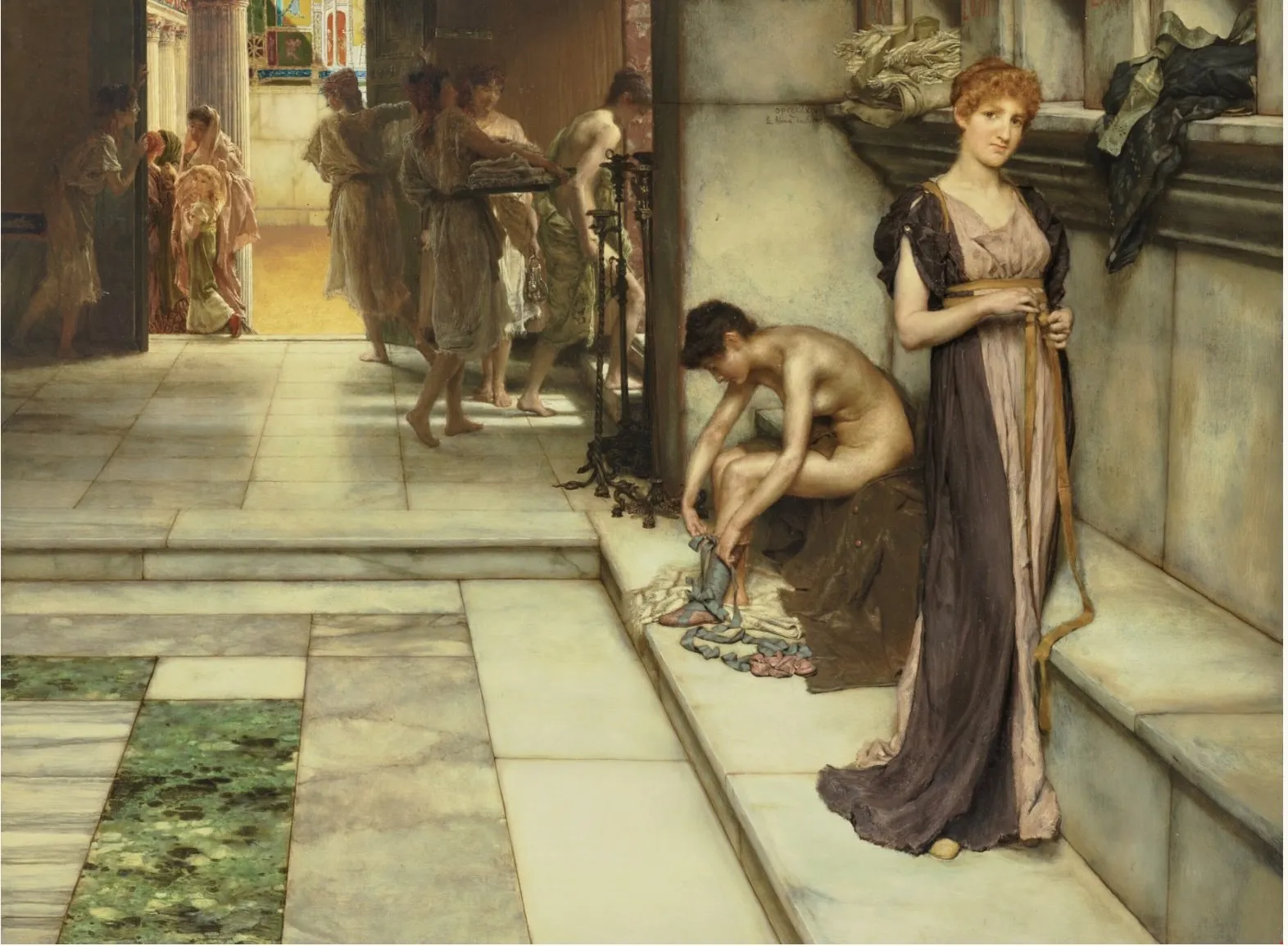
The journey begins in the Apodyterium, or changing room. In An Apodyterium (Opus 274), Alma-Tadema captures the vulnerability of this moment. A woman with red hair stands to the right, still draped in the armor of status—a purple and cream-colored gown with a golden girdle which she is beginning to unfasten. Beside her, a dark-haired woman is already nude, seated on a purple blanket, tying the blue bands of her sandals after her bath. The room captures the cycle of the Roman bathing ritual: one arrives, one departs, but both are stripped of their outer world.
In the background, we see a glimpse of what comes next. According to the 1913 Royal Winter exhibition catalogue, the stair at the right leads to "upper apartments used for massages and resting." It is a conveyor belt of relaxation.
Once the toga was removed, a Consul looked very much like a baker. This was the terrifying democracy of the baths. Without the purple stripe of rank, you were just flesh. But this room was also a place of danger—not from politics, but from petty crime. "Curse tablets" found in ancient drains are filled with angry pleas to the gods: "May he who stole my cloak while I bathed be consumed by fire!"
You hand your clothes to a slave, hoping they will still be there when you return, and step naked into the heat.
II. The Tepidarium: The Warm Transition
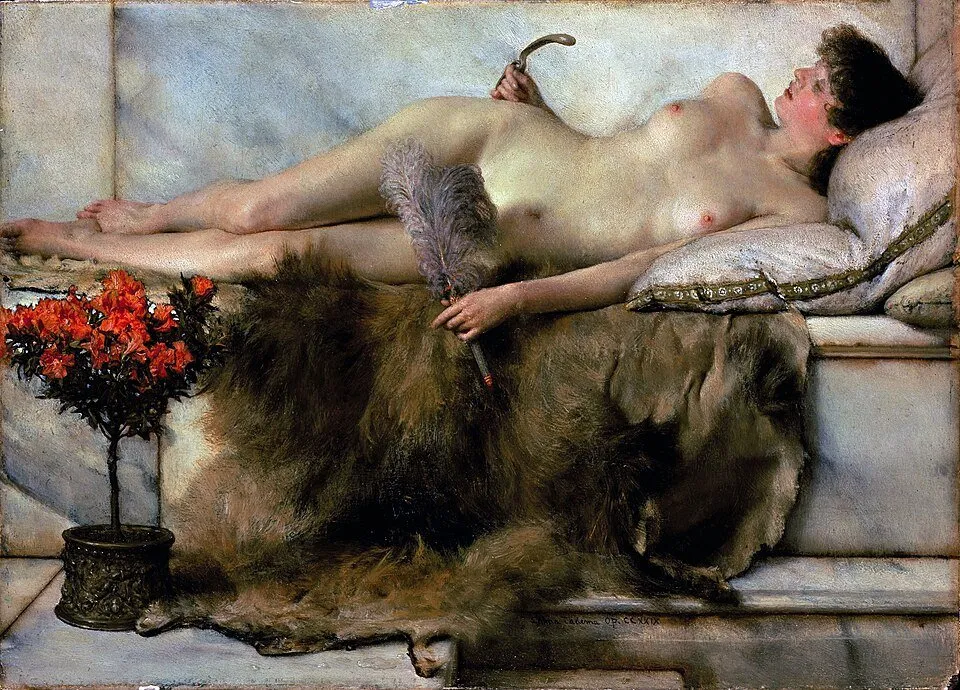
You do not rush into the fire. First, you must acclimate. You enter the Tepidarium, the warm room. There is no water here, only heated air radiating from the floor.
In his famous painting In the Tepidarium (Opus 229), Alma-Tadema shows us a woman reclining on a rug, flushed with the warmth. In her hand, she holds an ostrich feather fan and a strigil (scraper), ready for the next stage. She is in a state of suspended animation—not yet sweating, no longer cold.
This painting was so sensual that when A&F Pears (the soap company) bought it for an advertisement, they realized they couldn't use it. The Victorian public wasn't ready to associate this kind of languid Roman eroticism with their morning wash. But for the Romans, this was the point: to let the heat loosen the knots of the city before the evening's leisure began.
III. The Scraper in the Roman Bathing Ritual
From the warm room, you move to the Caldarium (hot room), a steam-filled sauna where the temperature could hit 140°F. You sweat until you can take no more.
Interestingly, Alma-Tadema seems to have avoided painting this room. Perhaps because the Caldarium was a place of steam and obscurity. Alma-Tadema was a painter of clarity—of cold marble, crisp sunlight, and distinct textures. Fog was his enemy. He takes us to the edge of the steam, but he never follows us inside. He leaves the sweating to your imagination.
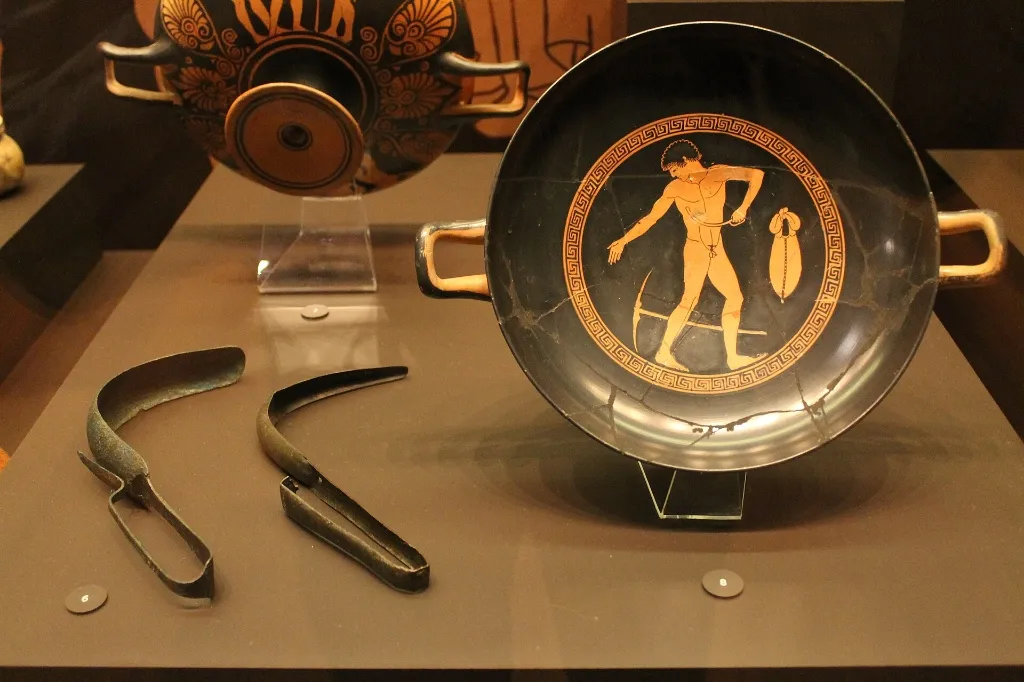
And then, once the pores are open and skin is slick with oil, the scraping begins.
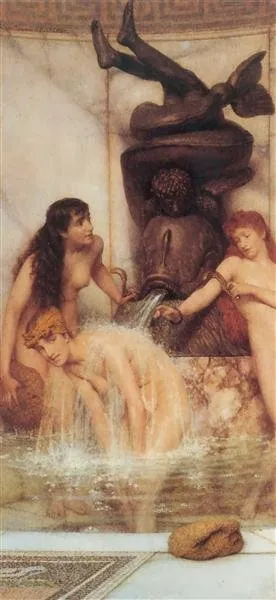
There is no soap. Instead, you are slathered in olive oil. In Strigils and Sponges (Opus 197), we see the result. The woman on the right is scraping her upper arm with a curved metal tool called a strigil. The blade acts like a squeegee, removing the mixture of oil, sweat, and dead skin in long, rhythmic strokes.
It was a vigorous, physical sensation—like a deep-tissue massage combined with exfoliation. The waste product was a sludge called strigmentum. For the average citizen, this was simply discarded, but the scrapings of famous gladiators were famously bottled and sold to fans as a medicinal ointment. To be Roman was to be scraped.
The Gross Truth: What exactly was in the bottle?
You asked, so here is the history. According to 18th-century encyclopedic records, Strigmentum was not just "sweat." It was classified into three distinct medicinal grades:
- Bath Strigments: The basic mixture of human sweat, oil, and dead skin.
- Palaestra Strigments: The "athlete's blend," mixed with the specific dust and earth from the wrestling grounds. This was prescribed as a poultice for sciatica and joint inflammation.
- Statue Strigments: Scraped from the walls and bronze statues of the baths to include verdigris (copper rust). This was used to cleanse old ulcers.
And yes, the texts confirm it was also applied to treat tumors and condylomata (warts/hemorrhoids). The Romans wasted nothing.
IV. The Frigidarium: The Cold Shock
Clean, oiled, and overheated, you now face the final challenge: the Frigidarium.
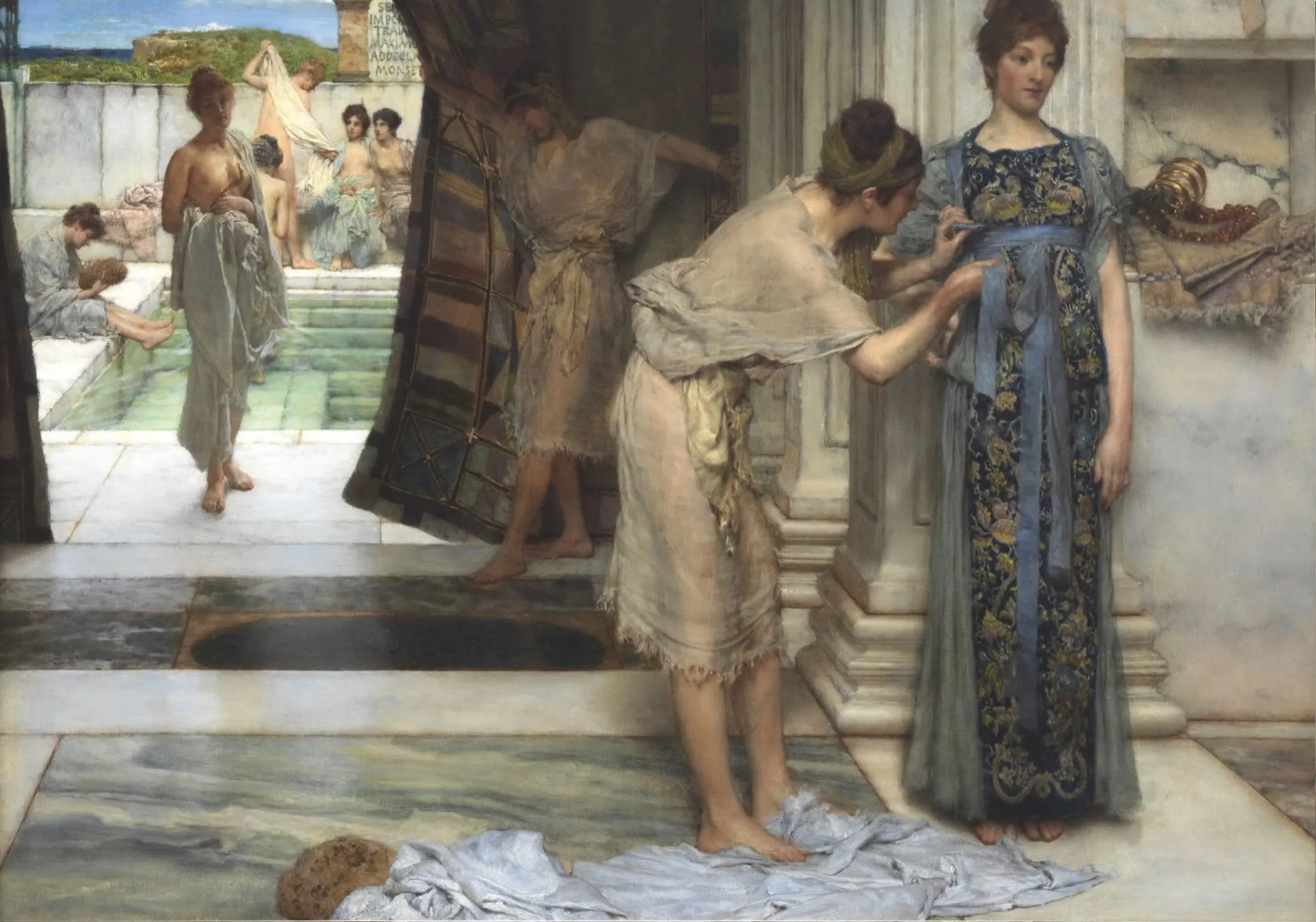
This is the cold plunge. You step out of the steam and dive into unheated water. The shock is immediate. Your pores snap shut. The lethargy of the heat vanishes, replaced by a surge of adrenaline.
In The Frigidarium (Opus 302), Alma-Tadema shows this moment of transition. The woman in the foreground is wrapped in a towel, perhaps hesitating before the plunge, while looking back at the warm rooms she has left. This painting, incidentally, was his first to be reproduced by heliogravure, a new technology that captured the granular texture of the stone perfectly—a fitting medium for a painting about tactile sensation.
V. Otium: The Afterglow
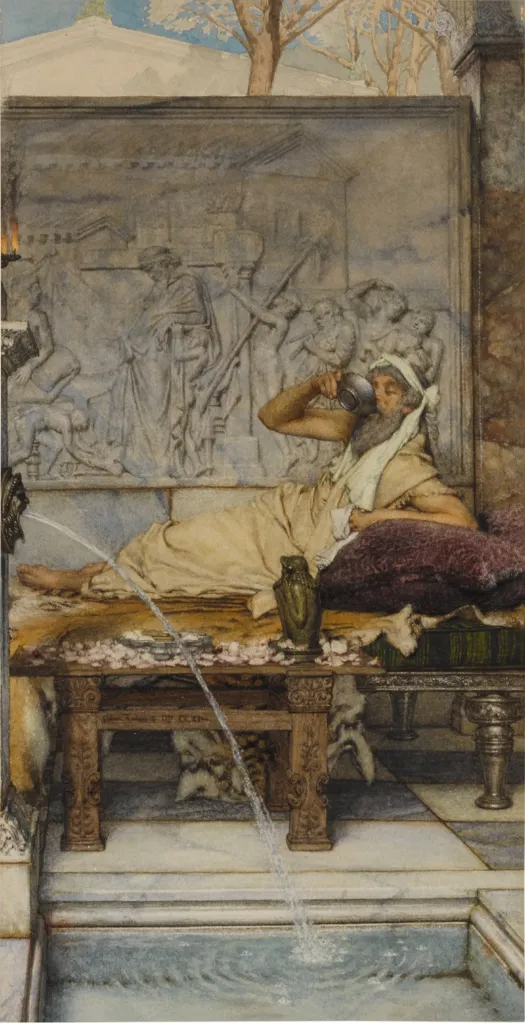
You emerge from the water reborn. You are dried with thick linens, perfumed with oils, and perhaps massaged. You step back out into the evening air, but you are not the same person who entered four hours ago.
You have achieved otium—cultivated leisure. In An Old Bachelor after the Bath (Opus 211), Alma-Tadema captures this specific feeling. The "Old Bachelor" sits by a fountain, a glass of wine nearby (or perhaps water), completely at peace. The noise of the city is gone. The dirt of the street is gone. He is ready for dinner, for conversation, for the evening.
This was the gift of the baths. It wasn't just about hygiene. It was a daily reset button for the soul. In a city of violence, noise, and ambition, the Roman bathing ritual was the one place where Rome stopped to breathe.
End of Trilogy Return to the Collections or explore The Life.
Leave a Visiting Card
Consulting the visiting cards...