The scent arrives before the ship.
It is 41 BC, on the banks of the Cydnus River in Tarsus. The air, usually thick with the dust of a Roman garrison town, suddenly carries a "wonderful passing sweet savour of perfumes." Then comes the music—the rhythmic, hypnotic stroke of silver oars keeping time to the sound of flutes and pipes. And finally, the vision itself breaks the horizon: a barge with a hull of burnished gold and sails of Tyrian purple, so saturated with dye that they seem to bruise the sky.
This is The Meeting of Antony and Cleopatra—not just a historical encounter, but the moment seduction became statecraft. When Lawrence Alma-Tadema painted The Meeting of Antony and Cleopatra (Opus 246) in 1883, he was not merely illustrating a scene from Plutarch or Shakespeare. He was documenting a masterclass in political theater.
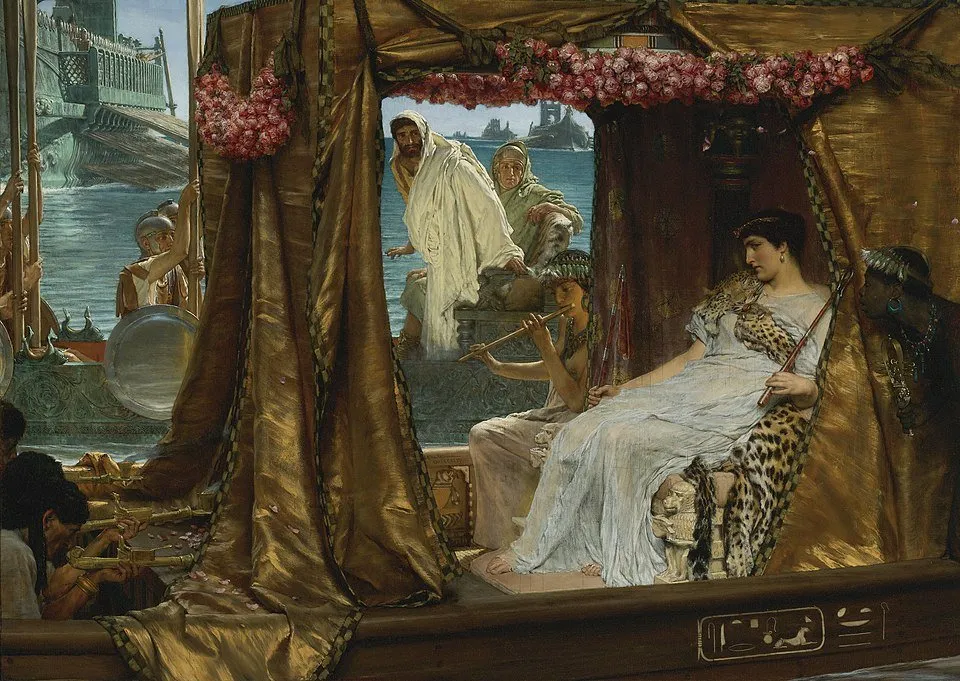 Lawrence Alma-Tadema, The Meeting of Antony and Cleopatra, 1883 (Opus 246)
The Architecture of Seduction
At first glance, the painting is a riot of sensory details—the transparency of the fabrics, the gleam of the leopard skin, the cool solidity of the marble. But look closer at the composition, and a ruthless power dynamic emerges.
Mark Antony, the Roman Triumvir, the conqueror of the East, is barely visible. He is relegated to the background, a small, distant figure framed—boxed in, really—by the openings of Cleopatra’s pavilion. He leans forward, grasping the side of his boat, his posture betraying a sudden, uncharacteristic timidity. This is the man who avenged Caesar, yet here, he is reduced to a spectator.
In the foreground, dominating the canvas, is Cleopatra. She reclines with an air of absolute, relaxed control. She is not looking at Antony; she is looking past him, or perhaps looking at nothing at all, secure in the knowledge that her stagecraft has already won the battle. She holds the traditional crook and flail of Egyptian sovereignty, but her true weapon is the spectacle she has created.
The Meeting of Antony and Cleopatra reveals what history often forgets: Cleopatra was not just a seductress; she was a brilliant politician who understood the power of the image. She knew that to secure Egypt's future, she could not appear as a supplicant before Rome. She had to appear as a goddess descending to earth. As Plutarch wrote, and as Alma-Tadema's painting confirms, "Venus was come to feast with Bacchus."
A Stage Built on Fact
The luxury depicted in The Meeting of Antony and Cleopatra is so overwhelming that it was long dismissed by critics as Victorian fantasy—a "Hollywood" version of antiquity before Hollywood existed. Yet, as is so often the case with Alma-Tadema, the fantasy is rooted in rigorous archaeology.
For decades, the idea of a "pleasure barge" of this scale was considered an exaggeration of ancient historians. But the recent 2025 discovery of a preserved thalamagos (cabin carrier) near Alexandria has vindicated both Plutarch and the painter. These were not mere boats; they were floating palaces, engineered for the calm waters of the Nile and the Cydnus, designed specifically to overwhelm the senses of anyone watching from the shore.
Alma-Tadema renders this floating palace with his trademark obsession for material reality. The gold of the barge is not just yellow paint; it is burnished metal, reflecting the Mediterranean sun. The "purple sails" described by Shakespeare are here shown in their full, heavy grandeur. Every texture serves the narrative: the softness of the queen's skin against the hardness of the jewels, the organic chaos of the flowers against the rigid geometry of the architecture.
The Shadow of Actium
Yet, for all its brightness, there is a shadow lying across the water.
Look at the bottom of the frame. Scattered across the water's surface are rose petals, debris from the festivities. In Victorian flower language, and indeed in the visual vocabulary of the 19th century, fallen petals were a potent symbol of transience. They suggest that this moment of triumph is fleeting.
The viewer knows what the figures in the painting do not. We know this meeting will lead to the famous "Alliance of the East," to three children, and to a decade of defiance against Rome. But we also know it leads to the Battle of Actium, to the biting asp, and to the suicide of the man currently staring in awe from the background.
It is this dramatic irony that elevates the painting from a historical illustration to a tragedy. We are witnessing the high water mark of the Hellenistic world, the final, brilliant flare of independent Egypt before it was swallowed by the Roman Empire.
A Legacy Resurrected
The painting itself has survived its own dramatic reversals of fortune. Commissioned in 1883 for the Gilded Age collection of Samuel Hawk, it was hailed as a masterpiece. But as the 20th century turned against Victorian art, it fell into obscurity.
In a twist that Cleopatra herself might have appreciated, it was rescued from oblivion not by a museum curator, but by a television star. Allen Funt, the creator of Candid Camera, purchased the work in the 1960s, at a time when Alma-Tadema’s paintings were often sold for the price of their frames. Funt saw the cinematic genius in the composition that the art critics had missed.
When The Meeting of Antony and Cleopatra sold at Sotheby's in 2011 for over $29 million, it was more than a record-breaking auction result. It was a vindication. It proved that the "Stage Director of History" still had the power to captivate an audience, two thousand years after she sailed up the Cydnus, and one hundred years after the artist who painted her had died.
Leave a Visiting Card
Consulting the visiting cards...