Heat.
That is the first thing you would notice. Not the glimmer of diamonds, nor the rustle of expensive silk, but the stifling, human heat of three thousand bodies pressed into the "sacred precincts" of Burlington House.
It is Wednesday, the 24th of June, 1891. Outside, Piccadilly is paralyzed. A continuous river of carriages has blocked the thoroughfare for hours, depositing the "cream of London" onto the pavement. They are all here: the Aristocracy, the Law, the Sciences, and, of course, the Art.
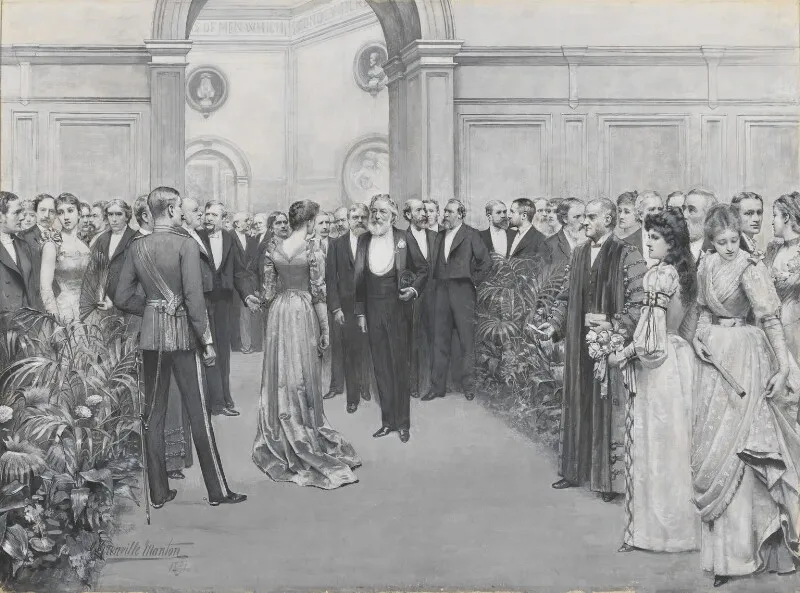
To enter the Royal Academy tonight is to enter the very center of the Victorian universe. But as the illustrator G. Grenville Manton captures in this frenetic drawing for Black & White magazine, it is a universe that is as exhausting as it is exclusive.
The Ascent to Olympus
The ritual begins on the stairs. They are lined with heavy banks of flowers, a fragrant corridor designed to mask the scent of the London streets. To ascend this staircase is a performance.
You are not merely walking; you are being judged.
At the top of the stairs, "gorgeously-attired porters" wait to announce you. This is the moment of terror. Your name is called out, floating over the hubbub, and you must step forward to face the Tribunal.
There, in the center of the vestibule, stands the President.
Jupiter Olympus
Sir Frederic Leighton does not just host; he reigns. In 1891, he has been President of the Royal Academy for thirteen years, and he has perfected the role of the "Jupiter Olympus" of the art world.
Manton draws him in the center of the composition (figure 21), staring intently at the approaching guests. He is famous for his "tedious function"—the endless stream of handshakes and bows. But watch closely. For his friends, there is a warm smile. For the mere acquaintances, purely a "dignified bow."
It is a court in all but name.
Standing near him, firmly embedded in the inner circle, is Sir Lawrence Alma-Tadema (figure 20). He is not an outsider here. By 1891, the Dutch painter has become a pillar of this English temple. While he stands dutifully in the receiving line tonight, one suspects he might prefer to be back at his own home in St John's Wood, hosting one of his boisterous musical evenings—where the air is thick with tobacco rather than perfume, and the songs are bawdy rather than polite.
But tonight, duty calls. The facade must be maintained.
The "Refreshment Antic"
Once past the terrifying judgment of the President, the guests spill into the galleries. Here, the glamour begins to fray at the edges.
The satirist Harry Furniss, a sharp-eyed chronicler of Victorian folly, coined a phrase for what happened next: the "Refreshment Antic."
While the inner sanctum dined on champagne, the thousands of guests were subjected to a culinary indignity that became a running joke. "Niggardly refreshments," Furniss called them. Imagine the scene: a Duchess and a High Court Judge jostling for a cup of lukewarm, overpriced coffee and a stale biscuit.
It was the great equalizer. The "Gold Cage" of the Royal Academy might have been gilded, but the catering was decidedly brass.
Ghosts in the Ink
Manton’s drawing was a feat of journalism, published just three days after the event. It was meant to be a snapshot of "Who’s Who."
We see the actors Ellen Terry and Henry Irving. We see the painter John Everett Millais, the former rebel turned establishment figure. We see the intricate hairstyles of the women in the foreground—perhaps the daughters of Henry Tanworth Wells, waiting their turn to be presented.
But look at the two figures standing directly before Leighton. Their backs are turned to us.
They are the "Types." The anonymous guests. The ones who braved the traffic, the heat, and the bad coffee just for a moment of recognition. They represent the thousands who climbed those stairs, hoping to be seen, hoping to matter.
The noise of that night has long since faded. The carriages have driven away from Piccadilly. The flowers on the staircase have wilted. All that remains is this wash of grey ink, a frozen memory of the night when all of London tried to squeeze into a single room.
Leave a Visiting Card
Consulting the visiting cards...