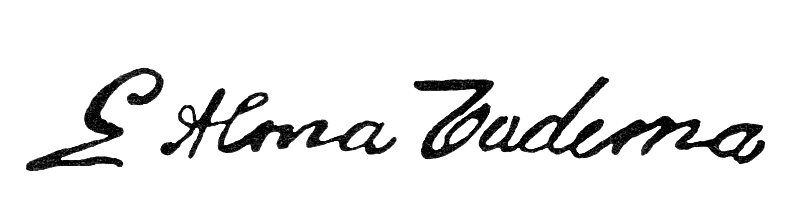
It is a spring morning in Lexington, Kentucky, in 1887. At the historic Ashland estate, General Henry Clay McDowell is registering his latest "blooded stock." He has chosen a name that signifies the peak of European cultural prestige, suggesting a pedigree as meticulously constructed as a classical painting.
He writes: Alma Tadema.
The Brand of Precision
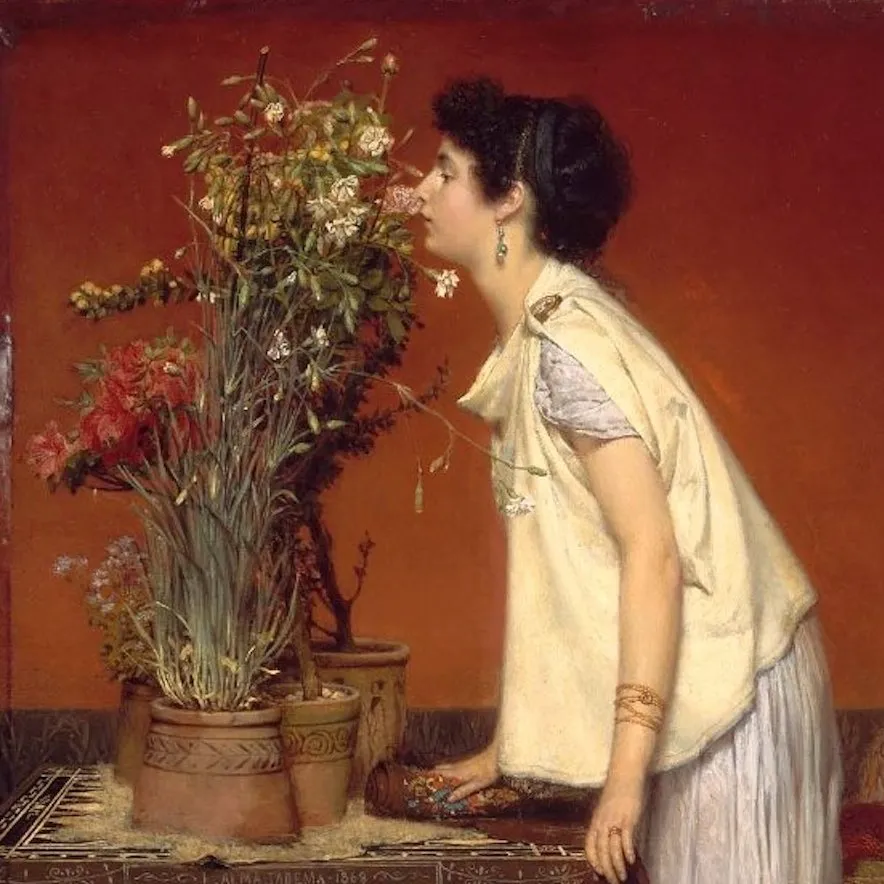
By the late 1880s, Lawrence Alma-Tadema had achieved a level of fame that transcended the art world. He was a global benchmark for "unimpeachable pedigree." To own an Alma-Tadema was to own proof of high social and intellectual standing.
In Kentucky horse breeding, where an animal’s value is dictated by the purity of its lineage, the name was a strategic marketing choice. McDowell understood that Alma-Tadema’s work was defined by what critics called "archaeological precision." In his stables, McDowell was attempting a similar feat: the reconstruction of the perfect horse through the "genetic precision" of the Standardbred line.
The $4,000 Colt
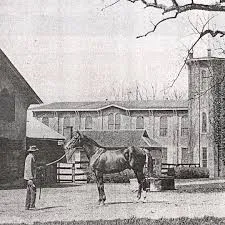
The horse was a bay colt, foaled in 1885. Sired by Dictator, a stallion of such high value that his name alone added thousands to a foal’s price, the animal was born into the "royalty" of the American track.
In late March 1887, news of a major sale began to circulate. On April 1, The New York Times published the official report in its "Sale of Blooded Stock" column:
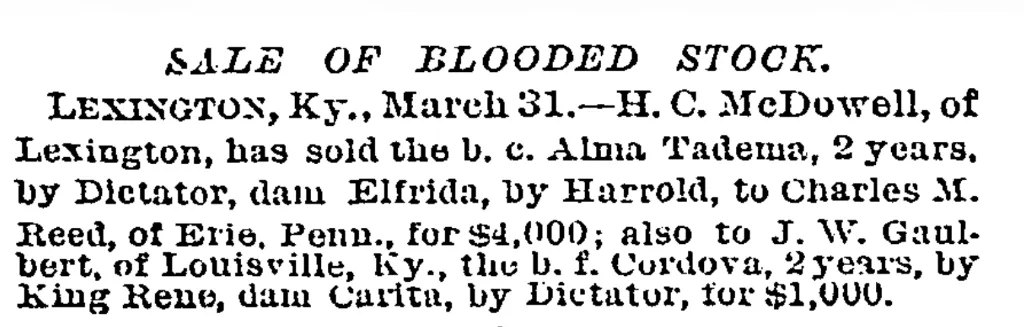
The sale of the young Alma Tadema for $4,000 was a significant event. In 1887, this sum (roughly $125,000 today) could have purchased a small original Alma-Tadema painting or a sizeable London townhouse. The name was a direct reflection of the animal’s perceived market value and elite pedigree.
The buyer was Charles M. Reed Jr. of Erie, Pennsylvania. The Reeds were railroad and shipping magnates—the exact class of Gilded Age financiers who were currently collecting Sir Lawrence’s massive marble canvases.
A Parallel Pedigree
The naming of this horse was a deliberate decision by McDowell to align his stable with a global brand. In the 19th century, the "Thoroughbred" and the "Academic Painting" were dual symbols of refined civilization.
Just as Alma-Tadema researched the exact texture of a Roman sandal or the specific grain of a marble slab, McDowell studied the "marks" and "seconds" of his trotters. Both men operated on the belief that greatness could be manufactured through the rigorous application of discipline and precedent. An Alma-Tadema horse, like an Alma-Tadema painting, was marketed as a "machine for excellence."
The Echo
We do not know if the Dutch painter in London ever learned that a Kentucky trotter bore his name. Nor do we know if Charles M. Reed Jr. ever connected the racing trophy on his mantel to the Tadema print on his wall.
But the name remains in the ledgers of the American Trotting Register. It serves as a reminder that the influence of Sir Lawrence leaked out of the studio, across the Atlantic, and into the very soil of the American South. The name Alma Tadema became a shorthand for a time when art and biological excellence were considered two sides of the same coin.
Leave a Visiting Card
Consulting the visiting cards...